




Key Highlights
- Certified Indian gold jewellery carries a BIS hallmark and a unique HUID code.
- Marks like GP, GEP, GF, and RGP mean the piece is not solid gold.
- A magnet test can flag base metals, but it cannot prove gold on its own.
- The vinegar test shows whether the base metal reacts.
- The float test and scratch test add useful clues when used together.
- Worn edges and skin discolouration can reveal plating underneath.
- Skip flame and acid tests, because they can damage jewellery and are unsafe.
- A jeweller with the right equipment can give a more certain answer.
- Digital gold is not a physical piece, so check how it is held before you buy.
Gold is one of the few things many Indian families keep for generations, which is exactly why fake and plated pieces are such a problem. Plated jewellery can look almost identical to solid gold under a shop's warm lights, and a thin outer layer can hide a cheaper base metal for years.
The good news is that you do not need a lab to check most pieces. A few careful looks and simple home tests can tell you a lot. Use these steps to detect fake or plated gold at home before you buy, sell, or accept gold as a gift.
One useful number to remember: a stamp of 750 means the piece is 75% pure gold, which is 18 karat. In this guide, we explain how to read stamps, run safe tests, avoid risky methods, and know when to visit a jeweller.
Quick Snapshot
| Check | What It Tells You | Main Limitation |
| Hallmark and HUID | Whether the piece is certified and traceable | Fake marks exist, so verify carefully |
| Plating marks (GP, GEP, GF, RGP) | Whether the piece is plated or filled | Unstamped antique pieces exist |
| Magnet test | Whether a magnetic base metal is present | Some base metals are not magnetic |
| Vinegar test | Whether the base metal reacts | Needs a few minutes and a rinse |
| Float test | Whether the piece is dense like gold | Some fake pieces are dense enough to sink |
| Ceramic scratch test | The colour of the streak | Leaves a tiny mark on the piece |
| Wear check | Whether plating has worn off | Only shows damage that already exists |
Why Fake and Plated Gold Is Hard to Spot
Gold is heavy, bright, and valuable, so anyone who wants to imitate it has a strong reason to try. Base metals like copper and brass can be shaped to look like a chain or a ring. Plated pieces go one step further. A thin layer of gold sits on top of a cheaper metal, and that layer can look very convincing in a dim room or a busy market.
The risk is not limited to shops. Many families receive old jewellery as gifts or inherit pieces without any papers. If you wear gold rings, necklaces, or bangles every day, you may be carrying more value than you realise. Knowing a few simple checks helps you protect yourself before you buy, sell, or accept gold from someone you trust.
Fake sellers also work online, so the same caution applies to digital platforms. Our guide on how to spot fake digital gold apps covers the warning signs to check before you hand over any money.
No single test is perfect, so think of each check as a clue. When several clues point in the same direction, you can be more confident about what you are holding.
Start With the Stamps: Hallmarks and Plating Marks
The fastest first check is to look closely at the piece. Use a magnifying glass on the inner band of a ring, the clasp of a chain, or the back of a pendant. Most genuine gold jewellery has a karat mark such as 18K or 22K, or a fineness number such as 750. A fineness number tells you the share of pure gold in the metal, so 750 means 75% gold.
Gold's market value also moves with inflation, interest rates, and global events, so the price you pay today may not match the price later. If you want to understand these forces, our article on why gold price trends change explains the main drivers. For now, the key point is that a piece's real purity matters more than its current price tag.
What a BIS Hallmark Looks Like
In India, certified hallmarked jewellery usually carries the official BIS logo along with a HUID, which is a unique identification code for that piece. You can check the HUID on the BIS Care app to confirm the details linked to it. If the marks look blurred, uneven, or cannot be verified, do not treat them as proof. Ask a jeweller to check the piece before you rely on the stamp.
Keep in mind that counterfeit pieces can carry fake marks too. A stamp is a helpful starting point, but it should not be the only check you use.
Plating Marks to Look For
Some stamps tell you directly that a piece is not solid gold. Look out for GP (Gold Plated), GEP (Gold Electroplated), GF (Gold Filled), and RGP (Rolled Gold Plate). If you see any of these, the piece has a gold layer over another metal.
The absence of any stamp is also a warning sign. Some antique or custom-made pieces can be unstamped, so an empty surface does not always mean fake. In those cases, rely on the home tests below and consider a professional check.
Real Gold vs Plated or Fake: A Quick Comparison
This table helps you compare what genuine gold does with what plated or fake gold tends to do.
| Test or Feature | Genuine Solid Gold | Plated or Fake Gold |
| Magnet | Does not attract a strong magnet | May be pulled toward a magnet if iron, nickel, or steel is used |
| Float (water) | Dense and heavy, sinks quickly | May float or hover if the base metal is light |
| Ceramic scratch | Leaves a yellow or gold streak | Leaves a black or grey streak |
| Vinegar | Keeps its bright colour and shine | Darkens, discolours, or turns greenish |
| Wear and skin | Does not tarnish or leave dark marks | Plating wears off, and the skin may discolour |
Simple Ways to Detect Fake or Plated Gold at Home
These checks are gentle and can be done in your kitchen or at a table. Use a clean cloth and work on a flat surface so nothing rolls away.
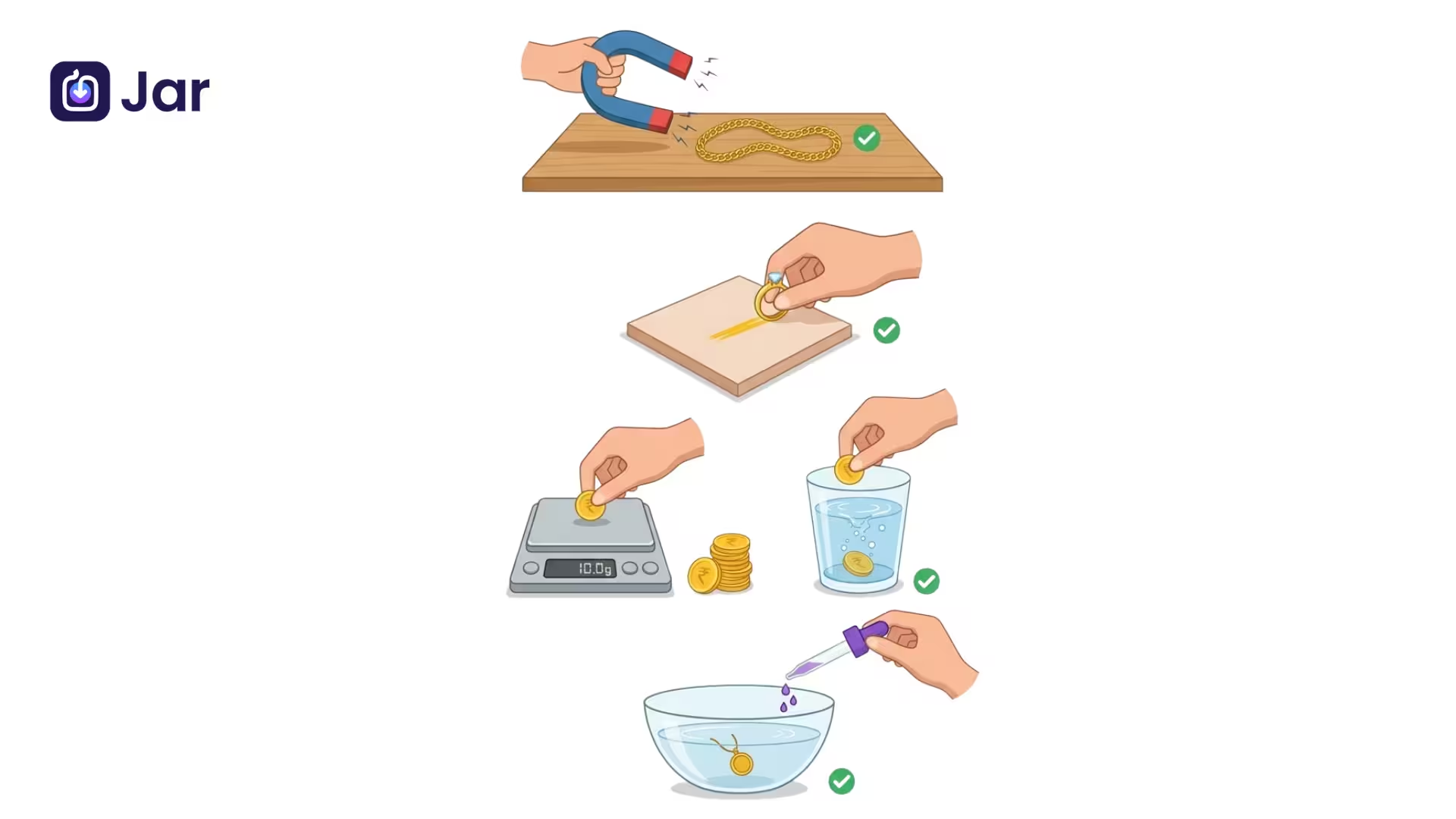
The Magnet Test
Hold a strong neodymium magnet close to the piece. Real gold is non-magnetic, so it should not cling to the magnet. If the piece is pulled toward it, the metal underneath is likely not gold.
The caveat matters. Many non-magnetic metals such as copper, brass, and aluminium can also be used in fake jewellery. So a piece that passes the magnet test is not proven real. It simply passed one check. Use the magnet as a quick first filter.
The Vinegar Test
Pour a little white vinegar into a small bowl, or place the piece on a plate and add a few drops. You can also soak it for a few minutes. Then rinse the piece with water and dry it well. Real gold keeps its colour and shine. If the metal darkens, turns greenish, or changes colour in any way, the base metal is reacting, which suggests the piece is plated or fake.
Scratched areas react faster, so pay attention to worn edges. Vinegar is a common household item and is gentle on genuine gold, but you should still rinse and dry the piece thoroughly afterwards.
The Float (Water) Test
Fill a clear glass with water and gently drop the piece in. Gold is very dense, so a real piece usually sinks straight to the bottom. If it floats or hovers in the middle, it may be made of lighter base metals.
This test works best on small items like pendants, coins, or earrings. Some fake pieces are made from metals that are dense enough to sink, so the float test is strongest when combined with other checks.
The Ceramic Scratch Test
Find an unglazed ceramic tile or the rough, unglazed base of a coffee mug. Gently drag the jewellery across the surface. A yellow or gold streak is a good sign. A black or dark grey streak means the item is likely plated or fake, because the base metal is showing.
Be aware that this test can leave a tiny scratch or a small residue on the piece. Try it on a less visible area, such as the inner part of a ring, and avoid using it on delicate or sentimental pieces you cannot afford to mark.
The Skin and Wear Check
Look closely at areas that rub the most: the edges of a ring, the clasp of a chain, and the inner band. If you see silver, copper, or a dull grey or brassy tone peeking through, the outer gold layer has worn away. Some people also notice green or dark marks on their skin after wearing a piece, which can be a sign of a reactive base metal.
This check only reveals damage that is already visible, so it cannot confirm that a worn piece is fake. It is still useful when you are judging an older piece you have owned for years.
Tests to Avoid at Home
Some online guides suggest heating gold with a lighter or testing it with strong acids. We do not recommend either method. Heat can change or melt a piece, which can damage solid gold and ruin a plated item. Strong acids are hazardous to handle, need proper protection and disposal, and are not suitable for a family's everyday jewellery.
If a home test seems to require heat or chemicals, stop and take the piece to a professional instead. A safe check that leaves your jewellery intact is always the better choice.
When to Visit a Professional
Home tests can give you strong clues, but they can miss complex alloys or hidden layers. For a more certain answer, take the piece to a trusted local jeweller or a certified assay office. Many of these professionals use electronic conductivity testers or X-ray fluorescence (XRF) spectrometers. These tools analyse the metal without harming the piece, which makes them a good choice for valuable items.
Before you visit, gather any bills, certificates, or hallmark details you have. Ask whether the test is non-destructive and request a written report if you plan to buy, sell, or insure the piece. If you are paying ₹50,000 or more for a chain or set, a few extra minutes of checking can save you a lot of worry later.
Once you know the gold is genuine, storage becomes the next concern. Our guide on where to keep your gold compares keeping gold at home, in a bank locker, and in a private vault, so you can pick the option that suits your situation.
Buying Digital Gold? Understand How It Is Held First
Many people who want to protect their savings also look at digital gold. It is important to know that digital gold is not a physical piece you can wear or test with a magnet. Instead, the gold is held on your behalf in a secure storage arrangement. Because of this, the home tests in this guide do not apply to digital gold.
What you need to check is how the gold is stored and who holds it. Look for clear details about the storage provider, the vault or custodian, and whether the gold is insured. Read the terms carefully to understand your rights if you want to sell, withdraw, or transfer your holdings. For a simple explanation of
this process, see our guide on how digital gold works behind the scenes.
Trust matters just as much as storage. Before you put money into any platform, check its credentials, reviews, and how it handles your data. Digital gold prices also move with the market, so returns are never certain.
If you want to start small, you can begin buying 24K digital gold on the Jar app. You can start with a small amount and check your holdings in the app anytime.
Digital gold prices move with the market, and returns are not guaranteed. This article is for information only and is not financial advice. Read the terms and check the storage and custody details before you invest.
Knowing how to detect fake or plated gold at home is a useful skill for anyone who buys, inherits, or sells jewellery. Start with the stamps, look for a BIS hallmark and HUID, and then run one or two gentle tests such as the vinegar or magnet check.
If the results still feel unclear, visit a professional who can test the piece without damage. If you are also exploring digital gold, take time to understand how it is stored and who holds it before you begin.
Frequently Asked Questions
Can I check gold at home without damaging it?
Yes, most common checks are gentle. The stamp check, magnet test, vinegar test, and float test do not harm the piece when done carefully. The scratch test leaves a small mark, so try it only on a hidden area. Avoid heat and acids, since they can damage your jewellery.
Is the magnet test enough to prove gold is real?
No, it is only a first filter. Real gold is non-magnetic, but several other metals, including copper, brass, and aluminium, are also non-magnetic. A piece that passes the magnet test still needs one or two more checks before you trust it.
What is HUID on gold jewellery?
HUID stands for Hallmark Unique Identification, a code given to each certified piece of gold jewellery in India. You can check the HUID on the BIS Care app to confirm the details linked to it. If the code cannot be verified, ask a jeweller to examine the piece before you buy.
Does a gold stamp prove that a piece is real?
Not on its own. Counterfeit items can carry fake marks, so a stamp should be checked closely and confirmed with another test or a professional. Treat a clear, verifiable hallmark as a strong sign, not a final answer.
Where can I get gold tested accurately?
A trusted jeweller or a certified assay office can run more accurate tests. Many use electronic conductivity testers or XRF spectrometers, which analyse the metal without damaging it. Ask for a written report if you plan to buy, sell, or insure the piece.