


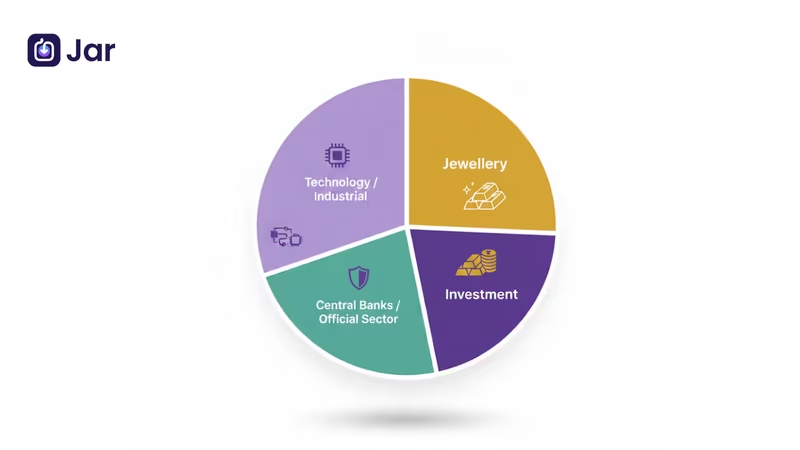


| TL;DR: India accounts for roughly 20-25% of annual global gold demand, making it one of the world’s largest gold markets. Jewellery drives - 55-60%of demand, led by weddings and festivals. Investment and household savings contribute 25-30%, reflecting gold’s role as long-term security. Technology and financial channels account for under 5% but increasingly shape how gold is accessed and bought. |
Gold has never been “just another asset” in India. It is worn, gifted, stored, inherited, and increasingly, invested in.
In fact, India consistently ranks among the world’s largest consumers of gold. However, this demand does not come from one place alone. It is spread across multiple sectors—each shaped by culture, income patterns, and changing financial behaviour.
Understanding these sectors helps explain why demand in India remains resilient, even as gold prices rise.
A quick look at India’s gold consumption
The demand for gold in India usually varies according to inflation trends, income cycles, wedding and celebration seasons, and how simple it is to obtain gold online.
These factors by themselves do not account for the continuously high demand. What sets India apart is how households view gold.
The FICCI - World Gold Council report shows that gold is both an investment and a regular expense. Jewellery and coins account for about 8% of household spending, similar to education and medical costs.
This mindset also explains why prices don’t easily curb demand. About 34% of buyers say they would continue purchasing gold even if prices rise, and 20% say they would buy more, keeping demand resilient over time.
Curious about where India’s gold actually comes from? Read: Gold Mines in India: The Untold Story.
1. Jewellery is still where India buys most of its gold
Most of India's gold demand comes from jewellery, with weddings and buying for the home making up about 55–60% of total demand.
Why jewellery dominates:
- Gold jewellery doubles as an adornment and long-term savings
- Weddings, festivals, and family milestones fuel consistent buying
- Jewellery is viewed as “safe wealth” across generations
Jewellery demand in India stays strong even during slowdowns because many households continue buying gold regardless of price changes or economic cycles.
What people actually do:
Families often buy small amounts of gold jewellery, 10g, 20g, or even less, when they have extra money, instead of waiting to invest big amounts.
2. Gold as an investment
The second major driver is gold investment demand.
This includes:
- Gold coins and bars
- Digital gold
- Gold-backed financial products such as gold mutual funds, gold ETFs, sovereign gold bonds, gold-backed crypto, and digital gold
WGC data shows that in recent years, investment demand (bars and coins) has risen to around 25-30% of India’s total gold demand. This is a significant rise from much lower levels in the early 2000s.
Why is investment demand growing?
- Gold is seen as a hedge against inflation
- Volatile equity markets push investors towards stability
- Digital platforms have reduced entry barriers
3. Gold as a family safety net
According to gold demand in Indian statistics, households, particularly those outside of major cities, account for a sizable amount of the demand for physical gold.
For many families:
- Gold acts as emergency savings
- It is easier to liquidate than property
- It carries no default risk
This form of gold demand rarely appears in formal investment statistics, but it plays a crucial role in overall Indian gold consumption.
| Did you know? Morgan Stanley estimates that the value of gold held by Indian households is approximately $3.8 trillion, or nearly 89% of the country's GDP. |
4. Gold use in tech and industrial space is increasing
Industrial use accounts for a small share of gold demand by sector in India—around 2-3%, far lower than jewellery or investment.
Gold is mainly used in electronics and semiconductors, medical devices, and precision instruments, where its conductivity and resistance to corrosion are critical.
Globally, technology demand makes up about 7-8% of total gold demand and is rising with growth in AI, semiconductors, and electric vehicles.
5. Financial sector and institutions: Indirect demand drivers
Banks, NBFCs, and financial institutions influence gold demand indirectly.
Their role includes:
- Offering gold-backed savings and lending products
- Encouraging the formalisation of household gold
- Creating easier access to gold investments
| Did you know? The Indian government introduced the Sovereign Gold Bonds program in 2015 to provide investors with exposure to gold prices without actually owning any gold. A fixed annual interest rate is another feature of these bonds. More than 130 tonnes of gold equivalent have been mobilised since then. |
Sector-wise contribution to gold demand in India
Understanding sector-wise gold demand reveals the economic and behavioural forces that keep gold central to Indian savings.
| Sector | Primary role in gold demand | Demand Stability |
| Jewellery | Driven by cultural traditions, weddings, and festivals | Very high |
| Investment | Wealth protection, portfolio diversification, and inflation hedge | Medium-high |
| Household savings | Emergency fund and long-term financial security | High |
| Technology and industry | Use in electronics manufacturing and medical applications | Low-medium |
| Financial Institutions | Providing access through gold-linked products and services | Indirect |
How modern access is reshaping gold demand
Gold continues to be valued for security and long-term wealth, but the path to ownership has become more flexible and accessible.
Today, buying behaviour is changing in a few key ways:
- Smaller, automated purchases are replacing large, one-time buys.
- Digital access has made gold bullion demand and micro-investing more common, especially among students and young professionals.
- Regular accumulation is preferred over waiting for surplus cash or price corrections.
What this means for Indian savers
Gold demand in India is shaped by layered behaviour rather than a single driver.
At the household level, gold serves as long-term financial security. At the same time, technology and finance are changing how people participate in gold ownership.
What has changed is not the trust in gold, but how it is owned. The Jar App lets users save money in digital gold over time by making small, automatic purchases without having to worry about storage.
FAQs on gold demand in India
Does India produce enough gold domestically?
No, India produces very little gold locally and relies heavily on imports to meet jewellery, investment, and industrial demand.
Why does India import almost all its gold?
India produces very little gold domestically, so imports meet jewellery, investment, and industrial requirements.
Why doesn’t gold demand fall sharply when prices rise in India?
Many households buy gold for long-term security, so purchases continue even when prices increase.