


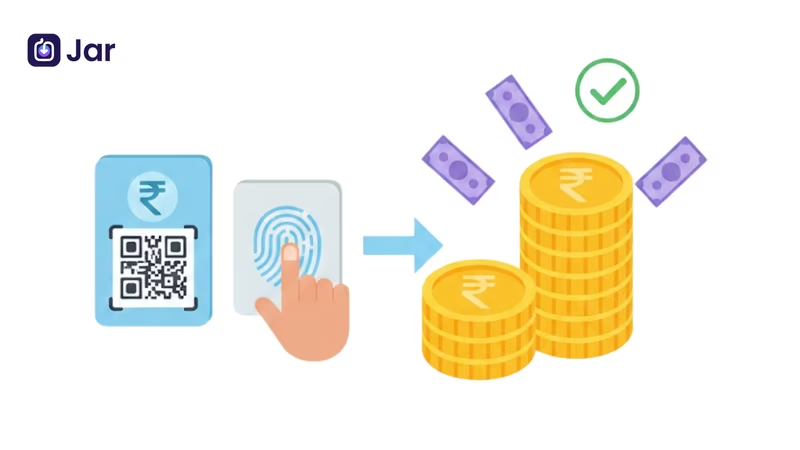


The Aadhaar Enabled Payment System (AePS) has become a core pillar of India’s digital and inclusive banking ecosystem.
It allows people to do basic banking using just their Aadhaar number and fingerprint/iris authentication, without needing a debit card, cheque book, or even a smartphone.
This makes AePS especially powerful for rural and low-income segments and brings in financial inclusion for people who may not be comfortable with traditional digital banking.
What is AePS?
AePS full form in banking is Aadhaar Enabled Payment System. AePS is a bank-led digital payment and banking framework developed by the National Payments Corporation of India (NPCI).
This helps customers access their Aadhaar-linked bank accounts using biometric authentication.
In simple words, AePS in banking is a system where:
- Your Aadhaar number is your key to your bank account
- Your fingerprint/iris is your PIN
- Transactions happen through micro-ATMs or Business Correspondents (BCs) appointed by banks.
In simple words, AePS stands for a cardless, PIN-less way of doing basic banking using Aadhaar and biometrics.
Because it connects Aadhaar and banking, many people also call it Aadhaar AePS or simply the Aadhaar-enabled payment system.
How does AePS Service work?
AePS is designed to be interoperable and simple for end users:
- Customer visits an AePS point
- This could be a local kirana shop, Common Service Centre (CSC), village-level entrepreneur, or banking correspondent with a micro-ATM / AePS machine.
- Shares Aadhaar and bank details
- Customer provides:
- Aadhaar number
- Bank name (the bank where their Aadhaar-linked account exists)
- Type of AePS transaction (cash withdrawal, balance enquiry, etc.)
- Biometric authentication
- The agent asks the customer to place their finger on the biometric device or look into an iris scanner.
- Biometrics are checked against UIDAI’s Aadhaar database.
- Routing via NPCI and the bank
- Once authenticated, the AePS NPCI switch routes the request to the customer’s bank.
- The bank checks the balance, debits/credits the account, and sends a success/failure response.
- Confirmation to the customer
- For a cash withdrawal, the agent hands over the cash.
- For non-cash services, a printed or SMS receipt is given.
Features of AePS
Key features that define AePS banking:
- Cardless & PIN-less
No debit card or ATM PIN is required. Aadhaar + biometrics are enough. - Interoperable across banks
Any Aadhaar-linked account from any participating AePS in the bank network can be used at any AePS-enabled BC/micro-ATM. - Micro-ATM-based
AePS runs via small handheld or desktop devices (often simply called an AePS machine or micro-ATM) at local shops or agents. - Online, real-time transactions
Transactions are routed via NPCI and processed in real time by banks. - Supports multiple basic services
Cash withdrawal, deposit, AePS balance enquiry, mini statement, Aadhaar-to-Aadhaar or Aadhaar-to-bank account transfers, etc. - Bank-led model
AePS is not a wallet or app; it is a regulated bank-led framework under NPCI and RBI guidance. - Low digital literacy requirement
Ideal for customers who cannot use UPI apps or net banking.
Because of these features, the AePS service is widely used in rural and semi-urban India to create “mini-ATMs” at last-mile points.
Benefits of the AePS Service
For customers, AePS brings several advantages:
- Access to banking near home
No need to travel to a bank branch or ATM. Local shopkeepers or BCs can provide services. - Financial inclusion
People without smartphones, internet, or cards can still withdraw cash, receive government benefits, and check balances. - Less dependency on physical branches
Reduces queues at branches and makes small-value transactions more efficient. - Secure biometric authentication
Fingerprint/iris-based authentication (combined with Aadhaar) reduces risks of PIN theft or card cloning. - Supports government benefit transfers
Pensions, MGNREGA wages, subsidies, and other DBT benefits can be withdrawn easily using Aadhaar.
Use the Jar app to start saving from ₹10.
For agents and retailers, AePS opens a new revenue stream through commissions on each AePS payment, withdrawal, or balance inquiry.
Who can use AePS?
Any individual customer can generally use AePS if:
- They have a bank account linked with Aadhaar (Aadhaar seeding completed)
- Their bank is live on the AePS network
- Their biometrics are captured and active in Aadhaar (UIDAI)
From the customer's perspective, no special registration is needed; linking Aadhaar with the bank account is usually enough.
From the agent/business side, banks and fintechs onboard retailers, give them an AePS machine, and create an AePS ID (many market players advertise “AePS ID free” or low-cost IDs as part of their offering).
Objectives of AePS
AePS was launched with a clear set of policy and product objectives:
- Promote financial inclusion by taking basic banking to unbanked and underbanked areas
- Enable direct benefit transfers (DBT) to beneficiaries’ Aadhaar-linked accounts
- Offer interoperable, low-cost infrastructure for small-value transactions
- Reduce cash handling at branches and reliance on physical banking infrastructure
- Enhance security using Aadhaar-based biometric authentication
- Standardise last-mile banking through micro-ATMs and business correspondents
Services provided under AePS
Under the Aadhaar-enabled payment system, customers can typically access:
- AePS cash withdrawal
Take out cash from Aadhaar-linked bank accounts via BC/micro-ATM. - Cash deposit
Deposit physical cash into the Aadhaar-linked account at certain AePS-enabled points. - AePS balance enquiry
Check the current account balance instantly. - Mini statement
Get a summary of recent transactions. - AePS money transfer
Aadhaar-to-Aadhaar or Aadhaar-to-bank account fund transfers are supported. - Merchant payments (Aadhaar Pay/AePS payment)
In some setups, customers can pay merchants directly from their Aadhaar-linked bank account using biometrics, without cash or card.
The exact menu of services can vary slightly across banks and AePS aggregators.
How to use AePS (Step-by-step)
For a typical customer, the process to use AePS looks like this:
- Ensure Aadhaar is linked to your bank account
- Visit your bank branch or use net banking or mobile banking (where available) to seed Ayour adhaar to your account.
- Find a nearby AePS point.
- Look for a BC/CSC, local kirana, or retailer with a micro-ATM or AePS machine.
- Carry your Aadhaar number and mobile number
- A physical Aadhaar card is helpful, but the number itself is key.
- Tell the agent what you want to do
- For example: cash withdrawal, balance enquiry, mini statement, fund transfer.
- Provide details
- Share Aadhaar number
- Select your bank name from the list
- Mention transaction amount (for withdrawals, deposits, transfers)
- Authenticate biometrics
- Place your finger on the scanner or look into the iris scanner.
- The device sends data via NPCI to your bank for verification.
- Receive cash or confirmation
- For withdrawal, you get cash and a receipt.
- For other services, you receive a slip or SMS with the transaction status.
If you are a retailer or CSC wanting to start AePS, you generally need to sign up with a bank or AePS aggregator.
For example, small businesses often search for AePS registration, SBI or similar to become a business correspondent of the State Bank of India and start offering AePS services to customers.
AePS Cash Withdrawal
AePS cash withdrawal is the most widely used AePS service. It allows customers to withdraw money from their Aadhaar-linked bank account through any AePS-enabled BC or micro-ATM.
How does the AePS cash withdrawal works
- Visit an AePS agent/BC/CSP with a micro-ATM.
- Ask for “Aadhaar cash withdrawal.”
- Provide:
- Aadhaar number
- Bank name
- Amount to withdraw
- Place your finger on the biometric device.
- Wait for transaction approval.
- Collect cash and a printed receipt/SMS as proof.
Because of this simple flow, many people in rural areas treat AePS points as their “local ATM”.
Transaction limit under AePS
There are two layers of limits to understand:
- NPCI framework limits
- Bank-specific limits
Per transaction and daily limits
- NPCI has indicated that AePS cash withdrawal per transaction is generally capped at around ₹10,000 for safety and fraud control, though banks can fine-tune within a specified range.
- Many banks and fintechs also restrict AePS withdrawals to a typical range of ₹10,000-₹25,000 per day per customer, depending on their internal policy.
Some guidelines and practices seen in the market:
- Many banks follow:
- ₹10,000 per AePS cash withdrawal
- Daily cumulative AePS limit is often around ₹50,000 (across multiple transactions)
- NPCI has also advised a limit on the number of AePS cash withdrawal transactions per customer per terminal per day (commonly up to 5 cash withdrawals) to control misuse.
Monthly limits
- AePS transactions (withdrawals + transfers) are often capped at around ₹50,000 per month, based on a rolling 30‑day period.
- Actual caps vary from bank to bank. Some banks have tighter or more relaxed limits.
Because bank policies change, always check your own bank’s latest AePS transaction and withdrawal limits via their website, customer care, or branch.
Limitations & challenges of AePS
While AePS is a powerful financial inclusion tool. However, it has certain limitations:
- Dependency on Aadhaar seeding
If Aadhaar is not correctly linked to the bank account, AePS will fail. - Biometric failures
Fingerprints not matching due to worn-out fingerprints (e.g., manual labour), sensor issues, or connectivity problems can cause repeated failures. - Connectivity & infrastructure issues
AePS relies on network connectivity at the BC point. Poor internet means failed or delayed transactions. - Limited transaction types & amounts
AePS is mainly for basic, low-ticket banking. High-value transfers or complex services still require other channels. - Fraud risks & misuse
If someone misuses biometrics (e.g., via cloned fingerprints) or tricks customers into giving Aadhaar information at untrusted outlets, fraud can occur—though biometric authentication reduces some traditional card/PIN risks. - Awareness gap
Many users are not fully aware of their rights, limits, or how to identify genuine AePS agents.
Things to consider before using AePS
Customers should keep the following in mind:
- Use only trusted AePS agents
Prefer agents recommended by your bank, CSCs, or well-known outlets. - Never share OTPs or sensitive details unnecessarily.
For basic AePS transactions, Aadhaar and biometrics are the main factors. Be cautious if anyone asks for additional sensitive details. - Check receipts and SMS alerts.s
Confirm that the debited amount and remaining balance on the receipt/SMS match youexpectationson. - Know AePS charges
- Many banks don’t charge customers directly for basic AePS services like balance enquiry or a few withdrawals.
- However, some agents may levy convenience AePS charges or commissions, especially beyond a free-usage limit.
- Always ask clearly about fees before transacting.
- Monitor the account regularly
Use passbook updates, bank app, or AePS mini statements to ensure no suspicious activity.
Know how your Credit Card, which is linked with UPI vs. Credit Card Payment on Digital Wallets is different.
AePS vs other services
Here is a comparison of AePS with other popular banking/payment modes:
| Feature/Aspect | AePS | ATM/Debit Card | UPI/IMPS/Net Banking |
| What you need | Aadhaar + biometrics | Card + PIN | Smartphone/internet + app/password |
| Typical use case | Rural cash withdrawal, DBT access | Urban cash withdrawal, POS payments | P2P transfers, online & merchant pays |
| Device used | Micro-ATM / AePS machine at BC point | ATM, POS terminal | Mobile phone/computer |
| User digital literacy | Very low | Moderate | Moderate to high |
| Limits | Low-ticket, strict caps per txn/day/month | Higher ATM limits | Varies by bank & mode |
| Authentication | Biometric (fingerprint/iris) via Aadhaar | PIN + sometimes OTP | PIN/password + OTP/biometrics |
| Best for | Financial inclusion & last-mile rural banking | Mainstream urban banking | Fast digital payments & e-commerce |
AePS is not a replacement for UPI or full-featured mobile banking; instead, it complements them by serving users who cannot or do not want to use app-based solutions.
FAQ on AePS
What is AePS in simple terms?
AePS stands for Aadhaar Enabled Payment System. AePS lets you do basic banking like cash withdrawal, deposit, balance enquiry and get a mini statement using your Aadhaar number and fingerprint instead of a debit card or ATM PIN.
What is an AePS transaction?
An AePS transaction means any allowed banking operation (such as cash withdrawal, deposit, balance enquiry, mini statement or Aadhaar-based fund transfer) done using an Aadhaar number plus biometric verification through a micro-ATM or BC device, routed via NPCI.
Is AePS safe?
AePS uses Aadhaar-based biometric authentication, NPCI’s secure switching infrastructure, and bank-level controls. This makes it relatively safe, though no system is 100% foolproof. Customers should transact only at trusted outlets and keep track of account statements.
Can I transfer money using AePS?
Yes, many AePS setups support AePS money transfer, such as Aadhaar-to-Aadhaar or Aadhaar-to-account transfers, subject to bank policies and limits.
In what ways are ATM withdrawals and AePS different?
In an ATM, you use a physical card and PIN to withdraw cash. In AePS, you visit a BC/retailer and use Aadhaar plus biometrics to withdraw cash through a micro-ATM / AePS machine. Both debit your bank account, but the access method and location are different.
Are there any AePS charges for customers?
Basic services like balance enquiry or a few withdrawals may be free from the bank’s side, but some agents may charge a small convenience fee per transaction. Charges also vary by bank’s internal policy. Always confirm AePS charges before using the service.
Do I need a special registration at my bank to use AePS?
In most cases, you just need your Aadhaar correctly linked to your bank account. For example, if your Aadhaar is linked to your SBI account, you can use AePS through SBI or any interoperable AePS point—there is no separate AePS registration SBI step for customers beyond Aadhaar seeding.
Which organisation manages AePS?
AePS is operated and standardised by the National Payments Corporation of India (NPCI), under RBI oversight, and implemented by banks. That is why you will often see references like AePS NPCI in documentation and guidelines.
What does AePS stand for again?
AePS stands forAadhaar Enabled Payment System, a secure, bank-led, Aadhaar-based framework that brings basic banking services to the last mile.