


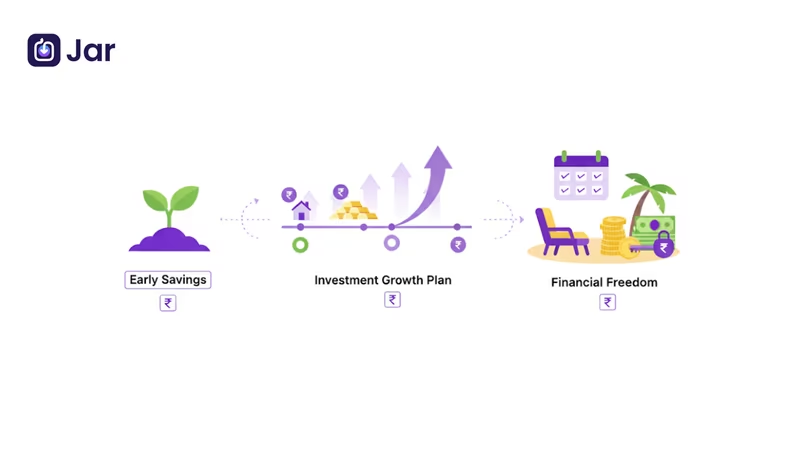


| TL;DR: Financial freedom happens when your savings and investments can cover your expenses without relying on a salary. Start with the 25x rule, automate your savings, and stay consistent. |
Most people don’t think in terms of financial freedom. They just want to stop feeling stressed every time money comes up.
Stress shows up in small ways. Wondering if your salary will stretch till month-end, getting irritated when an unexpected expense pops up, or staying in a job longer than you want because the bills don’t really give you a choice.
Financial freedom is what gradually takes care of these pressures, without requiring extreme lifestyle changes. Let's talk about what it means to be financially free, how to set a goal, and the habits that will help you reach that goal.
What is financial freedom?
Financial freedom means you have enough savings and investments to cover your regular living costs if your income stops or changes.
Rent, groceries, bills, and basic commitments don’t immediately become a crisis if one salary cheque is delayed.
You don't have to stop working or live on a limited budget forever. It means that work becomes more flexible. You can switch jobs, take a hiatus, or make less money for a bit without everything falling apart.
The 25x rule: A simple way to estimate financial freedom
Start with your annual expenses - not what you hope to spend, but what your life actually costs right now. Add up rent, groceries, utilities, insurance, transport, and other regular expenses that don’t disappear even if you change jobs.
Here’s how it works:
Your yearly expenses today → multiply by 25 → your approximate financial freedom corpus
Example:
If your yearly expenses are ₹5 lakh, multiplying by 25 gives you a target of ₹1.25 crore.
This gives you a rough estimate of how much money needs to be invested so your expenses aren’t entirely dependent on your salary anymore.
7 rules that keep your finances on track
Most financial stress comes from weak systems underneath everything else.
These rules focus on putting that system together first, so saving and investing don’t feel dependent on mood, timing, or short-term situations.
Rule 1: Stabilise your savings before you start investing
If saving only happens when you feel motivated, investing will always feel uncertain. You’ll keep second-guessing whether you can stay invested or whether you should pause the moment expenses rise.
This means deciding on a fixed amount that leaves your account regularly—weekly or monthly—right after income comes in.
If staying consistent feels difficult, money-saving apps can help automate small savings and reduce overthinking.
Rule 2: Clear high-interest debt early
High-interest debt quietly cancels out progress, even when everything else looks “on track.” Credit cards, personal loans, and rolling EMIs keep taking money away before it ever gets a chance to grow.
If your investments earn around 10-12% but your debt costs 30-40%, the math is already working against you.
Clearing this kind of debt gives a guaranteed improvement to your finances and frees up cash for saving and investing. To tackle debt systematically, read this guide on five effective strategies to get out of debt.
Rule 3: Start small instead of waiting for a higher income
Many people plan to start investing “properly” once they earn more. In practice, this often means not starting at all.
Small, regular amounts do something important: they build the habit first. Once the habit exists, increasing the amount later feels natural, whereas trying to start big from scratch usually feels overwhelming.
Rule 4: Choose investments you can actually stick with
Constantly switching investments often hurts more than it helps. Every change introduces hesitation, timing risk, and the temptation to react emotionally to short-term market moves.
Simple investments you understand make it easier to stay invested during ups and downs. If you're unsure where to begin, this beginner's guide to saving and investing walks you through the basics.
Over time, staying invested through full market cycles matters more than picking the “perfect” option.
Rule 5: Use automation to reduce decision fatigue
Making money decisions every month is exhausting, even for disciplined people. Automation removes that burden.
Tip: Fix a small amount to move automatically right after salary credit - first into savings, then into investments.
Rule 6: Use gold as a stabiliser
Gold isn’t meant to make you rich quickly. Its value lies in balance.
Allocate a small, fixed portion of your savings to gold and add to it gradually, so it cushions volatility without replacing long-term growth investments.
Rule 7: Focus on building systems
Financial progress rarely follows neat timelines or fixed dates.
Set up savings and investments to run automatically, decide allocations in advance, and review them just once or twice a year.
Where to put your money once the basics are sorted
Choose options that are simple to understand, simple to keep track of, and simple to stick to.
- Index funds: For long-term wealth building through consistency.
- Equity mutual funds: For long-term goals with professional management
- Debt instruments: For shorter-term goals or stability.
- Gold/Digital gold: As a supporting asset for balance and flexible investments that fit any budget.
- Real estate: Once income and savings are stable.
- Automated, small-ticket investments: Wealth building through automated investments.
Small changes in everyday saving can help you free up more money for investing without major lifestyle changes.
| Financial freedom vs. financial independence Financial freedom is the confidence and flexibility to make life choices without constant money worries. Financial independence is when your investments make enough money to pay for your basic needs. |
Thinking beyond the short term
You don't become financially free all of a sudden. It gets bigger as you save and spend more systematically.
Starting small is enough. With the Jar app, even everyday spare change can go into digital gold, helping you stay consistent without needing a big upfront amount.
FAQs on financial freedom
1. What does financial freedom mean?
Being financially free means that you don't need a regular paycheck to cover your living costs. You can do this by saving money and investing it.
2. What is the 4% rule of financial freedom?
The 4% rule suggests you can withdraw 4% of your invested corpus each year in retirement without running out of money over a 30-year period.
3. What are the 4 pillars of financial freedom?
The four pillars are typically earning enough income, spending less than you earn, saving and investing consistently, and protecting your wealth with insurance and emergency funds.
4. What is the 3-6-9 rule of money?
The 3-6-9 rule suggests keeping 3 months of expenses for emergencies, 6 months saved if you have dependents, and 9 months if your income is irregular or you're self-employed.