

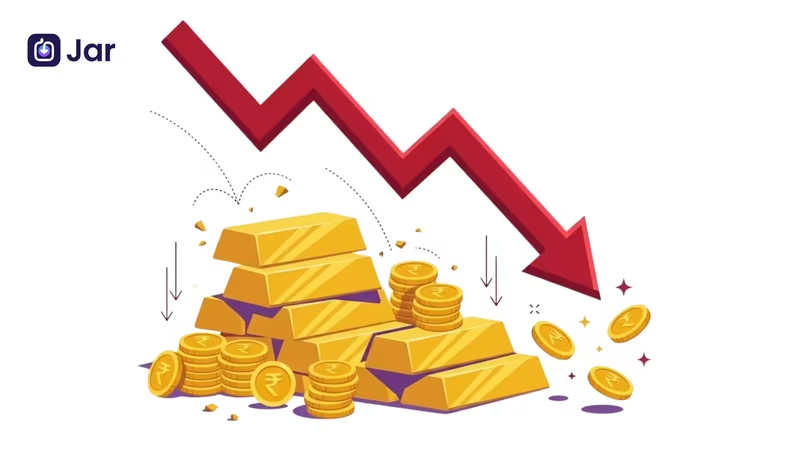


If you've checked the gold prices in the last few days, you've probably noticed how far it has dropped. MCX spot data shows gold down about 30% from its recent peak. That's a big move for a metal many Indians treat as a store of value.
This article covers the main reasons for falling gold prices, what the drop means for gold loan borrowers, and how investors can think about buying during a dip.
Key Highlights
- MCX spot data shows gold down 30.19%, from ₹1,76,306 to ₹1,23,077 per 10 grams.
- Profit booking after a long rally, a stronger US dollar, and higher bond yields are among the main reasons gold is falling.
- A falling gold price raises the loan-to-value (LTV) ratio on a gold loan, which can lead to repayment demands or top-up requests.
- RBI data shows loans against gold jewellery rose 66% year on year to over ₹3.74 lakh crore in September 2026.
- Buying in parts over time can reduce the risk of buying just before another fall, but it doesn't remove the risk of loss.
What Is Triggering the Recent Fall in Gold Prices?
Gold has dropped for several reasons at once. Investors took profits after a steep rally, the dollar and US bond yields firmed up, and some of the fear-driven buying faded. No single factor explains the whole move, so it helps to look at each one.
The Resurgent US Dollar and Rising Treasury Yields
Gold pays no interest. A government bond does. So when US bond yields rise, bonds look more appealing to anyone who wants steady income.
Take a simple, fictional case. Suppose you have ₹10 lakh to invest. A bond paying 5% would bring in about ₹50,000 a year, if the rate holds. Gold could still beat that if its price rises enough, but that outcome isn't certain.
A stronger dollar adds pressure, since gold is priced in dollars globally. For Indian buyers, the rupee matters too. A weaker rupee can soften the impact on rupee prices, while a stronger rupee can make the fall hit harder. You can read more about inflation, interest rates and global risk and how these forces connect.
Shifts in Global Geopolitics and Tariff Speculation
Gold tends to draw buyers during wars, political shocks, and trade fights. Over the past year, worries about global trade policy and geopolitical conflicts pushed many investors toward it. That buying helped send prices up.
Fear doesn't stay at the same level, though. Once a crisis looks more predictable, some investors cut their gold holdings, even if the underlying tension is still there. What matters is how investors expect the risk to change.
Central Bank Buying Trends: A Shift from Aggressive Buying to Consolidation
Central banks hold gold as part of their reserves. Their buying can give prices support. When they slow down, the market loses one of its steadier buyers.
Their moves don't always make headlines, but they shape the market over time. You can read more about central bank gold buying and what it means for everyday savers.
Historical Pullbacks vs Structural Downtrends: Is This a Normal Correction?
A correction is a drop inside a bigger trend. A structural downtrend lasts longer and usually reflects lasting changes in demand.
The recent fall looks more like a cooling-off period after an unusually strong rally. A 30% drop is large, though, so it's fair to ask whether it's something more. That's hard to tell in the moment. Look at months of data and the reasons behind the move, not just the last few sessions.
The Ripple Effect: How Lower Gold Prices Impact the Broader Economy and Markets
A falling gold price reaches more people than gold owners. Borrowers can see their safety cushion shrink quickly. Jewellers see demand shift with price, and lenders are starting to watch their portfolios more closely.
Impact on Gold Loan Borrowers: LTV Limits, Margin Calls, and Top-Up Demands
A gold loan is secured by the gold you pledge. The lender sets a loan-to-value (LTV) ratio, which is the share of the gold's value it will lend.
Consider this illustrative case, which isn't from any specific lender. You pledge gold worth ₹1 lakh and borrow ₹70,000, so your LTV is 70%. If gold falls 20%, your collateral is worth ₹80,000. The loan is still ₹70,000, so the LTV rises to about 87.5%.
If the LTV climbs past the lender's limit, you may be asked to repay part of the loan or pledge more gold. If you can't, the lender can auction the pledged gold. Falling prices also make recovery harder for lenders, which is why they track LTV closely. Before you borrow, read up on gold loan rules and interest rates.
The numbers show how fast gold loans have grown. RBI data cited in recent coverage puts loans against gold jewellery at over ₹3.74 lakh crore in September 2026, up 66% from ₹2.25 lakh crore a year earlier.
Lenders are also flagging early signs of stress. Piramal Finance's CEO said that across its portfolio, customers with an active gold loan with another lender have risen to above 35%, from 20 to 25% two years ago. Bajaj Finance said its Stage 2 and 3 assets rose to 2.02% of loans, from 1.87% in the previous quarter. Part of that rise came from short-tenor gold loan schemes that the company no longer offers.
Lenders also say this isn't yet a sign of widespread trouble. Still, the trend is worth watching.
Impact on Jewellers and Retail Demand: Why Cheaper Gold May Spur Festive and Wedding Buying
Lower prices can bring back buyers who held off when gold was at its peak, especially ahead of weddings and festivals.
The metal price is only part of the bill, though. Making charges and GST can add a large share. A lower gold rate doesn't always mean a jewellery bill drops by the same amount.
Equities and Currencies: How Capital Rotates from Safe Havens to Growth Assets
Gold loan stocks have also taken a hit. Muthoot Finance shares fell about 8.5% over five days, Manappuram Finance dropped more than 11%, and IIFL Finance fell 4% in the same period.
Money can also move out of gold and into other assets, such as stocks. That doesn't happen every time, and stocks carry their own risks.
The Downside Risk: Will Gold Rates Fall Further or Rebound?
Nobody can say for sure whether gold will keep falling or bounce back. According to the coverage, global prices have dropped below $3,600 an ounce from over $5,500. The outlook depends on interest rates, the dollar and investor demand. Plan for more than one outcome instead of betting on one forecast.
Key Support Levels and What Macro Analysts Are Forecasting
Technical traders watch support levels, which are prices where buyers stepped in before. If prices break below one, some traders expect more selling. Others see the same level as a chance to buy.
Read more than one view before you act, and be careful with any single target price.
Inflation and Currency Hedge: Why Long-Term Demand Remains Resilient
Many people hold gold to protect against inflation and a weakening currency. Over long periods, that role has mattered for some holders.
Gold can still stay flat or fall for years. Think of it as a long-term hedge, not a guarantee.
The Common Mistake: Why Trying to Time the Exact Bottom Usually Backfires
Waiting for the bottom sounds sensible. The trouble is that you only see the bottom in hindsight. Prices can turn up while you're still waiting.
A lower price alone doesn't guarantee a quick recovery. A clear plan, with a set amount and a set schedule, is usually easier to stick to than guessing the lowest point.
Turning the Drop into an Advantage: Why Falling Prices Are a Buying Opportunity
A lower price can make gold more appealing, but only if the purchase fits your budget and goals. Start by checking how much gold you already hold. Then decide how much you can invest without strain, and spread your buying over time.
Rupee-Cost Averaging (RCA): How Dips Automatically Lower Your Average Gram Price
With rupee-cost averaging, you invest the same amount at regular intervals. Lower prices buy more grams, and higher prices buy fewer. Over time, your average cost moves toward the lower prices you paid.
Here's a fictional example with made-up prices. Priya invests ₹2,000 in gold each month.
- Month 1: Gold is ₹7,000 per gram, so she gets about 0.286 grams.
- Month 2: Gold is ₹6,000 per gram, so she gets about 0.333 grams.
After two months, she has put in ₹4,000 and holds about 0.619 grams. Her average cost is roughly ₹6,462 per gram, below the ₹6,500 you'd get by simply averaging the two prices.
The Staggered Accumulation Strategy: Buying Small During Correction Waves
Staggered buying means purchasing in smaller amounts over weeks or months, instead of all at once. That lowers the chance your whole budget lands near a peak. You can do it by hand or on a schedule. Many people use a fixed plan, such as staggered buying through a Gold SIP, because it keeps them consistent when headlines look scary.
Digital Gold as a Dip Vehicle: Eliminating Minimum Buy Limits and Storage Overhead
Digital gold lets you buy small amounts online. You don't need a full coin or bar, or a locker at home.
The costs don't vanish. Check GST, the gap between buy and sell prices, who holds the gold, and how easily you can sell it.
How to Capitalise on Lower Rates with Digital Gold on Jar
If you'd rather not check prices every day, automation can do some of the work. Jar is a digital gold app that lets you start small and buy on a schedule. Digital gold still moves with the market, so returns aren't guaranteed.
Start with as Little as ₹10 to Avoid Committing Large Lump Sums
You can begin with ₹10. That gives you a way to test the habit before you commit a larger amount.
Automated Daily Savings: Locking in Lower Rates Incrementally Without Staring at Charts
Automated savings buy on a schedule you choose, so you don't have to guess the bottom. Each purchase happens at that day's price. You can pick a daily, weekly or monthly amount and pause when money is tight. To get started, you can set up automated daily savings in a few steps.
24K Pure Gold Backed by Secure Vaults
Digital gold in the app is 24K, the purest form of gold. Purity is only one part of the picture. Ask how the gold is stored, who holds it and whether it's insured.
Instant Liquidity: Cash Out or Convert to Physical Coins Whenever You Choose
You can sell digital gold or convert it into physical coins. Your payout depends on the price on the day you sell. Fees and withdrawal times can change, so check the current terms before you need the money.
Frequently Asked Questions
Why is gold falling right now?
Gold is falling because several forces are working together. Investors are taking profits after a steep rally, the US dollar and bond yields have firmed, and some of the buying driven by geopolitical fear has eased. These drivers can change quickly, so prices can also recover quickly.
What are the main reasons for falling gold prices?
The main reasons are profit booking after a long rally, higher US bond yields, a stronger dollar, and less demand from investors who bought gold because of geopolitical fears. Uncertainty about interest rates also plays a part. No single factor explains the whole move.
How does a falling gold price affect a gold loan?
A falling gold price lowers the value of the gold you pledged, which pushes your LTV higher. If the LTV goes above your lender's limit, you may need to repay part of the loan or pledge more gold. If you can't, the lender can auction the gold. Check your lender's LTV rules and keep a safety buffer.
Where can I check the gold price today?
You can check the MCX spot price or a trusted financial site. Note the time of the quote, because gold prices move during the trading day. Your jeweller's rate will also include making charges and GST, so it won't match the exchange price.
Should I buy gold now that prices have fallen?
A lower price doesn't automatically make gold a good buy. Start by checking how much gold you already hold and how much you can invest comfortably. Spreading purchases over time can reduce the risk of buying just before another drop, but it doesn't remove the risk of loss.