

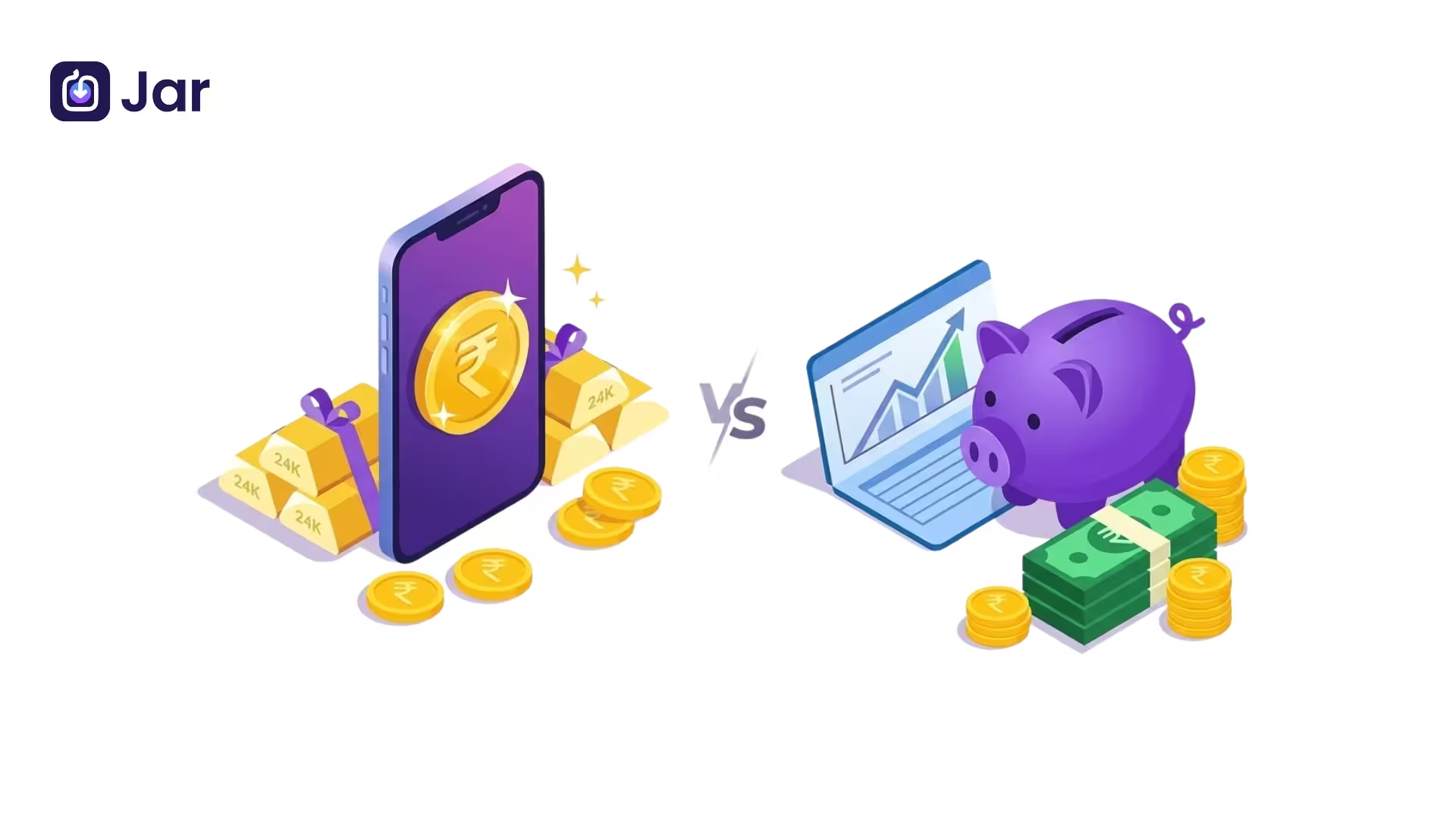


Key Highlights
- PPF is a government-backed, tax-free option with a 15-year lock-in and a yearly contribution cap of ₹1.5 lakh.
- Digital gold lets you start with small amounts and sell quickly, but its price can fall and its buy-sell spread adds a hidden cost.
- Gains on digital gold held for more than 24 months are taxed as long-term capital gains, while PPF returns are tax-free under current rules.
- Your time horizon matters most. Short goals need liquid money, medium goals suit a mix, and long goals can hold more of either.
- Neither option is the "winner" for every goal. Most people do best with a core and a smaller satellite position.
You want to save for something big, like a home down payment, a child's education, or retirement. You've heard about digital gold and the Public Provident Fund (PPF), and both sound like sensible choices. But which one should you pick?
Here's the short answer: it depends on when you need the money. This guide compares digital gold and PPF on the things that actually matter for long-term goals: real costs after tax, how easily you can get your money out, and how much risk you're taking on.
You'll finish with a simple way to decide which fits your goal, or how to use both.
What Is Digital Gold, and How Does It Work?
Digital gold lets you buy gold online in small amounts, and the provider holds the physical metal for you in a vault. You can buy, sell, or convert it to physical gold later. Its value follows the gold price, so it rises and falls with the market.
Think of it like owning a small slice of a gold bar kept in a secure locker. You don't carry it around, but you still own the gold. You can learn more about the mechanics in our guide on how digital gold works.
What Is PPF, and How Does It Work?
PPF is a long-term savings scheme backed by the government of India. You deposit money every year, and the interest rate is set by the government and reviewed every quarter. The money is locked for 15 years, though you can extend the account in 5-year blocks.
The biggest selling point is the tax treatment. Under the EEE (exempt-exempt-exempt) status, your contributions, interest, and maturity amount are tax-free, within the annual limit of ₹1.5 lakh.
The Real-Cost Test: What You Actually Keep
The headline return is only part of the story. To compare fairly, look at what you keep after costs and taxes.
Digital gold costs:
Buy-sell spread: Platforms usually sell gold at a slightly higher price than they buy it back. This gap is a cost you pay every time you enter or exit.
- GST and platform charges: Check whether the buying price you see already includes these.
- Capital gains tax: Applies when you sell at a profit (see the tax section below).
PPF costs:
- No spread or fund charges: The interest rate is declared upfront.
- Opportunity cost: Money locked for 15 years can't be moved to a better opportunity if your plans change.
- Missed contributions: Skipping the yearly minimum can make the account inactive and needs a fee to revive.
Example: Suppose Priya buys ₹10,000 of digital gold, and the buy-sell gap is 3%. Her gold is worth about ₹9,700 the moment she buys it. The gold price has to rise about 3% just for her to break even. This is a fictional example to show how spreads work, not a prediction.
Digital Gold vs PPF: Head-to-Head Comparison
| Factor | Digital Gold | PPF |
| Backing | Physical gold held by the provider | Government of India |
| Return source | Gold price movement | Government-set interest rate, reviewed quarterly |
| Tax on gains or interest | Capital gains tax on sale (depends on holding period) | Tax-free under EEE status |
| Lock-in | None | 15 years (extendable in 5-year blocks) |
| Liquidity | Sell anytime during market hours on the app | Partial withdrawals from year 7; limited early closure |
| Minimum investment | As low as ₹1 on some platforms | ₹500 per year |
| Yearly cap | None | ₹1.5 lakh |
| Price volatility | High | Low (fixed rate for each quarter) |
| Hidden costs | Buy-sell spread, GST, platform charges | Opportunity cost of locked money |
| Best fit | Flexible, smaller allocation | Long-term, low-risk core |
You can also compare gold against other options. Our breakdown of gold investment schemes in India covers the wider field.
Is Digital Gold Safe?
Digital gold is only as safe as the provider holding your gold. Its price can drop, and it's not a bank deposit, so it doesn't get deposit insurance.
Before you buy, check:
- Who stores the gold, and where
- Whether the gold is insured
- Whether the provider is transparent about its buy and sell prices
You can read more about who holds your digital gold, custody, ownership and insurance. It's also worth reading about whether digital gold is regulated in India before committing money.
PPF is safer in terms of principal and returns because it's backed by the government. Its rate can still change each quarter, so you won't get a fixed rate for 15 years.
If you want to start adding gold to your savings in small amounts, Jar lets you do that.
Can You Sell Digital Gold Anytime?
Usually, yes. You can sell digital gold in the app and get the money in your bank account. Many people also withdraw to UPI. The timing and limits depend on the platform, so check the process before you need the money. Here's how the withdrawal process to UPI works.
PPF is far less flexible. You generally can't withdraw until the account is seven years old, and partial withdrawals are limited. Loans are also available from the third to the sixth year, but these aren't the same as access to your full balance.
How Is Digital Gold Taxed in India?
Gains on digital gold held for more than 24 months are treated as long-term capital gains. Under rules effective from July 2024, these are taxed at 12.5% without indexation. Gains on sales within 24 months are added to your income and taxed at your slab rate.
PPF returns are tax-free under EEE status, so there's no tax to pay at maturity.
The exact rules can change and depend on your situation. Check the digital gold tax rules in India and confirm with the Income Tax Department or a tax advisor before filing.
The 3-Horizon Verdict: Which One Fits Your Goal?
The right choice depends on how long you can leave the money alone. Use these three horizons as a starting point.
Horizon 1: Under 3 Years
Neither is a good fit. Digital gold can drop in value at the wrong time, and PPF locks your money for too long. Consider a liquid fund or a fixed deposit instead.
Horizon 2: 3 to 7 Years
Digital gold can work as a diversifier, but keep it to a small share of your savings. PPF is also limited here because most of your money stays locked. If you're deciding between a regular deposit and gold for this window, our RD vs gold scheme comparison looks at the trade-offs.
Horizon 3: 10 Years or More
This is where PPF makes the strongest case as a safe core, especially for tax-free, government-backed savings. Digital gold can serve as a smaller, tactical part of the portfolio. Over long periods, gold's role is usually to diversify your savings rather than to be the main engine.
The Actionable Playbook: How to Split Your Money
Use these simple rules as a starting point:
- Build the core first. Put your long-term, low-risk money into PPF if you can, within the ₹1.5 lakh cap.
- Add a small satellite. Keep digital gold as a smaller slice of your savings. Many investors keep gold to a modest share of their portfolio.
- Match the lock-in to the goal. Only lock money you won't need for 15 years.
- Keep an emergency fund outside both. Don't use PPF or digital gold for emergencies.
- Review once a year. Rebalance when your goal gets closer or your income changes.
For a deeper look at portfolio weights, read our guide on how much gold to hold in your investment portfolio.
Practical Example
Fictional example: Rahul is 32 and saving for a child's school fund due in 12 years. He sets aside ₹10,000 a month. He puts ₹8,000 into PPF for the long-term core and ₹2,000 into digital gold as a smaller, flexible slice. He'll review the split each year and avoid selling gold in a short-term dip.
Key Takeaways
- PPF suits a long-term, tax-free, government-backed core, but it locks your money for 15 years.
- Digital gold is flexible and easy to start, but it has price risk and hidden costs like the buy-sell spread.
- Your goal's timeline matters more than which product has the higher headline return.
- A split approach, with PPF as the core and digital gold as a smaller satellite, works for many long-term goals.
Frequently Asked Questions
Is digital gold better than PPF for long-term goals?
Neither is better for every goal. PPF suits a long-term, low-risk core because it's government-backed, tax-free, and locked for 15 years. Digital gold suits a smaller, flexible slice of savings because its price can swing and its costs and tax rules are different.
Is PPF interest tax-free?
Under EEE status, PPF contributions, interest, and maturity amounts are tax-free, within the ₹1.5 lakh annual contribution limit. Check current Income Tax Department rules for your situation.
How is digital gold taxed in India?
Gains on digital gold held for more than 24 months are taxed as long-term capital gains at 12.5% without indexation under rules effective from July 2024. Gains on shorter holdings are added to your income and taxed at your slab rate. Confirm current rules before filing.
Can you withdraw digital gold anytime?
Usually, yes. You can sell digital gold on the app and withdraw the money to your bank or UPI. Timing and limits depend on the platform.
Is digital gold safe?
Digital gold carries price risk and depends on the provider storing the gold. Check who holds the gold, whether it's insured, and whether the platform is transparent about its buy and sell prices.