



Key Highlights
- Gold jewellery costs more than its gold content because of making charges, and GST applies on top.
- With a 15% making charge and 3% GST, the gold has to rise about 18.5% before you get back what you paid.
- Coins, bars, ETFs, digital gold, and sovereign gold bonds usually carry lower costs and sell closer to the market price.
- Jewellery gives you something investment gold can't: value from wearing it and from the occasions it marks.
- Keep most of your gold money in investment gold, and buy jewellery only for what you'd actually wear.
Say you're buying gold for a wedding, a gift, or your savings. You see a beautiful necklace in a jeweller's shop, and then you wonder whether you should put the same money into gold meant only for investing.
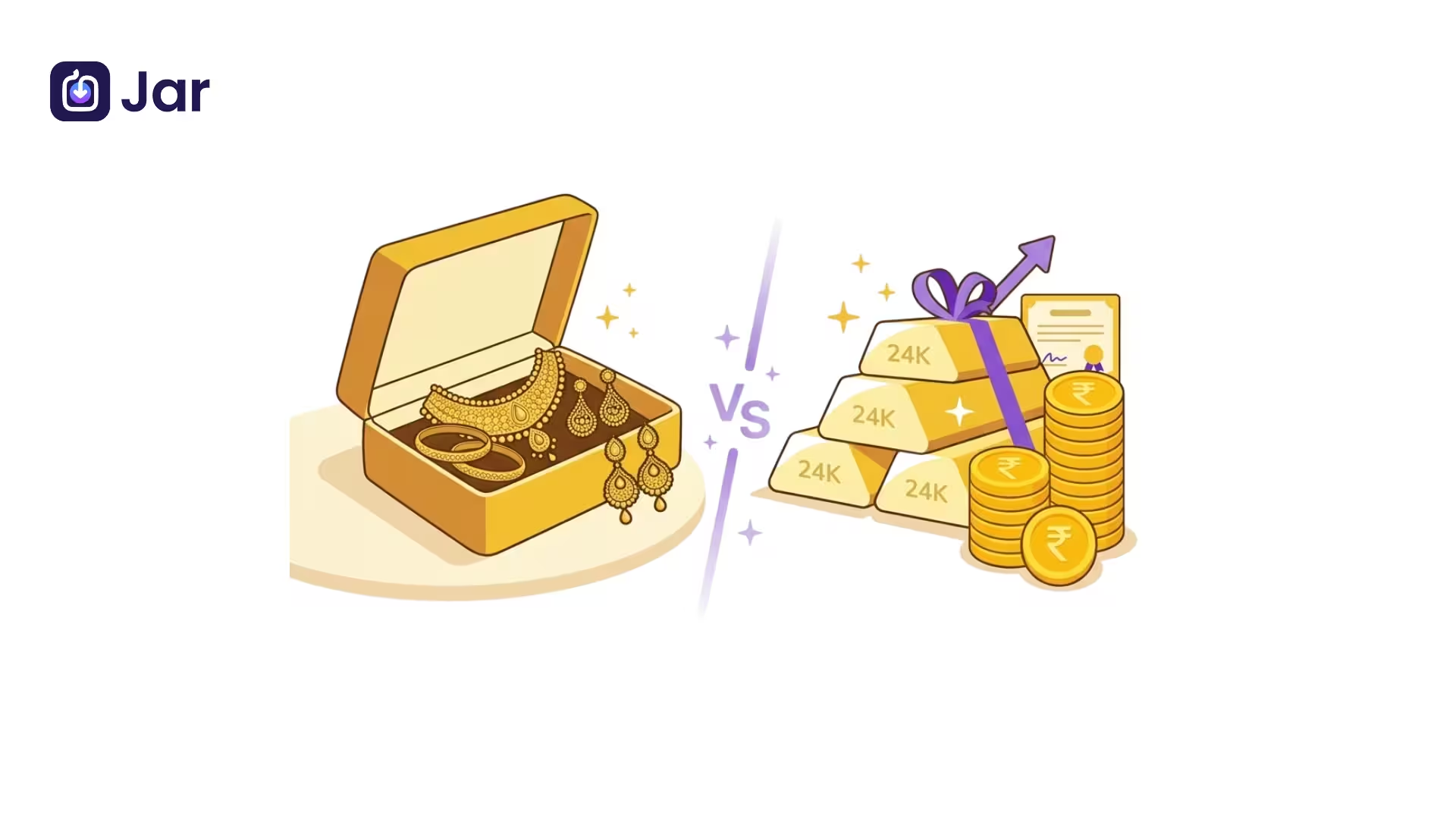
Both are gold, but they don't behave the same way with your money. Jewellery comes with extra costs that investment gold often avoids.
This article explains those costs in plain numbers, compares the main options, and gives you a simple way to decide. By the end, you'll know which kind of gold fits your goal.
The Foundational Benchmark: 4 Criteria That Decide Gold's Real Value
Before you compare jewellery with investment gold, check four things: purity, the costs added on top of the gold, how quickly you can sell it, and why you're buying it. These decide how much of your money actually ends up as gold.
Purity vs Price: What 22K, 18K, and 24K Actually Mean for Your Rupee
Karat measures how pure gold is, out of 24 parts. 24K is pure gold. 22K is about 91.6% gold, and 18K is 75% gold. The more gold in a piece, the more of your money goes into the metal itself. If you want a quick primer, read understanding gold karats.
Making Charges, GST, and Wastage: The Three Layers Between Your Money and the Gold
Making charges are what a jeweller charges to turn gold into a design. They're usually a percentage of the gold value, and they're often the biggest extra cost. You can learn more about how they're calculated in gold making charges explained.
GST of 3% is added to the total on most gold jewellery in India. Some jewellers also charge for wastage, which is the small amount of gold lost during crafting.
Liquidity: How Fast You Can Turn Gold Into Cash
Liquidity means how quickly you can sell something at a fair price. Coins, bars, and ETFs are easy to sell at the day's market rate. Jewellery is harder. When you sell it, the buyer usually pays only for the gold's weight and purity, minus deductions.
Purpose Fit: Are You Buying Gold to Wear, to Store Value, or to Hedge?
Ask yourself why you're buying. If you'll wear it at a wedding or on festivals, you're paying for use and meaning. If you're building savings, you care more about cost and how easily you can sell. Most of the confusion comes from mixing these two goals.
Where Gold Jewellery Shines (And Where It Quietly Makes Sense)
Gold jewellery is strong on emotion, family tradition, and use. It's a poor pick for pure savings, but it can be a good choice when you'd buy it anyway. Its value comes from how you use it.
Emotional and Ceremonial Value: Weddings, Gifting, and Family Traditions
Gold is part of many Indian ceremonies and gifting traditions. A necklace passed down through generations has value that a bar in a locker doesn't. That value is real, but it's personal, so only you can decide how much it's worth to you.
Wearable Returns: When Jewellery Delivers Value Every Time You Wear It
Imagine Meera buys a ₹50,000 gold chain for a family wedding. She wears it at three functions this year. For her, the cost per wear is what matters, not the resale value. Jewellery makes sense when the wearing is the reason for buying.
Hallmarked Jewellery (BIS 916/750): How to Verify Purity Before You Pay
Look for a BIS hallmark on the piece. A "916" mark means 22K gold, and a "750" mark means 18K gold. Hallmarking helps confirm purity, so always ask for it before paying.
The Reality Check: The Hidden Cost Gap Most Buyers Miss
Making charges, GST, and buyback deductions together mean jewellery starts well below its gold value. The numbers below show how far the gold has to move before you break even.
The Making Charge Drag: Why a 15% Making Charge Means Gold Must Rise About 18.5% to Break Even
Here's the formula:
Total you pay = Gold value × (1 + making charge) × (1 + GST)
Break-even rise = Total you pay ÷ Gold value − 1
Let's take a fictional example. Assume gold is priced at ₹7,000 per gram. This is an assumed rate for illustration, not a current price.
- Gold weight: 10 grams
- Gold value: 10 × ₹7,000 = ₹70,000
- Making charge (15% of gold value): ₹10,500
- Subtotal: ₹80,500
- GST (3% of subtotal): ₹2,415
- Total paid: ₹82,915
To get back ₹82,915 at a sale, the gold would need to be worth ₹82,915. That's 82,915 ÷ 70,000 − 1 = 18.45% higher than your purchase-day rate.
Buyback Haircut: What Jewellers Deduct When You Sell Jewellery vs Bars
Jewellers often deduct for purity testing and wastage when you sell back. Say a jeweller deducts a hypothetical 3%. To receive ₹82,915 after that cut, the sale value would need to be ₹85,479. That's about 22% above the original gold value.
Check how your piece's value is calculated before you buy. You can use this resale value of gold jewellery calculation guide to estimate it.
Purity Shrinkage: Why Stones, Enamel, and Alloys Add Weight but Not Gold Value
A piece may weigh 10 grams, but not all of that is gold. Stones, enamel, and alloys add weight and cost, but they don't add gold value. Ask for the gold weight and purity separately on the bill.
Lock-In Cost: The Opportunity Cost of Money Sitting in a Locker
Money spent on jewellery is money you can't use somewhere else. If your ₹82,915 earned nothing while locked in a locker, you also lost any other return you could have earned on that money. Storage costs, such as locker fees, add to this.
Head-to-Head Comparison: Jewellery vs Coins/Bars vs ETFs vs Digital Gold vs SGBs
Here's how the main options compare at a glance. Terms vary by provider and change over time, so check current details before you buy.
| Option | Making charges | GST | Storage | Selling | Extra feature |
| Gold jewellery | Yes, usually a percentage | 3% on purchase | Locker or home | Buyback with deductions | Wearable |
| Coins and bars | Lower premium than jewellery | 3% when bought from a jeweller | Locker or home | Market rate minus dealer spread | Hallmarked |
| Gold ETF | None | Not applicable | Demat account | Market rate on the exchange | Easy to trade |
| Digital gold | Usually none; buy/sell spread applies | Varies by provider | Held by the provider | Sell in app at the provider's rate | Small amounts |
| Sovereign Gold Bond | Issue price set by RBI | Not applicable | Held electronically | Market rate on exchange, or at maturity | Fixed interest of 2.5% a year |
You can read more about the differences in gold coins vs gold bars: which to buy for investment and what a gold ETF is.
Cost Structure Comparison: Making Charges, Premiums, and Fees
Jewellery has the highest layer of extra costs. Coins and bars carry a smaller premium. ETFs and digital gold have fees or a buy/sell spread, but no making charge. Sovereign Gold Bonds have no making charge, and they pay interest on top of gold price movement.
Storage, Safety, and Verification Comparison
Physical gold needs a locker or safe storage, and you have to verify its purity yourself. ETFs and SGBs are held electronically. Digital gold is held by the provider, so check how the gold is stored and insured before you buy.
Tax Treatment Comparison: Holding Periods and Capital Gains Rules
Tax rules differ for each option, and they have changed in recent years. Holding period, the type of gold, and whether the gain is short-term or long-term all affect what you owe. Read the digital gold tax rules in India guide, and confirm current rules with a tax professional before you sell.
Liquidity and Exit Comparison: Time to Cash and Realistic Recovery Value
ETFs can be sold on the exchange during market hours. Coins and bars can be sold to a dealer, usually at a small spread. Jewellery usually gives you the lowest recovery value. SGBs can be sold on the exchange or held to maturity, but early exit is only possible after the lock-in period.
The Nuanced Verdict: The Purpose-Cost Split Framework
Gold jewellery isn't always a bad choice, and investment gold isn't always the right answer. The better question is what you're buying the gold for, and how much you're willing to pay for that purpose.
Introducing the Purpose-Cost Split: Use Gold for Wearing, Hold Gold for Wealth
Split your gold money by purpose. Money for wealth should go into low-cost forms with easy exits. Money for wearing and occasions can go into jewellery, as long as you accept the higher cost on purpose.
The Tier Model: Tier 1 Wealth Gold vs Tier 2 Lifestyle Gold
- Tier 1 Wealth Gold: Coins, bars, ETFs, digital gold, and SGBs. The goal is to store value at low cost and sell easily.
- Tier 2 Lifestyle Gold: Jewellery you plan to wear. The goal is use and meaning. You accept the making charges and GST as the price of wearing it.
Here's a fictional example. Rahul has ₹1,00,000 for gold this year. He puts ₹80,000 into Tier 1 Wealth Gold through an ETF and digital gold. He puts ₹20,000 into Tier 2 Lifestyle Gold for a necklace he'll wear at family events. He knows the necklace needs about an 18–22% rise in gold before he breaks even, so he's paying for the wearing, not for profit.
For a sense of how much of your money should sit in each tier, read how much gold should you hold in your investment portfolio.
If you want to start a Tier 1 habit with small amounts, digital gold is one option. Jar lets you buy 24K digital gold in small amounts. Compare providers on storage, fees, and withdrawal options before you choose.
When Jewellery Is Still the Right Call Despite Higher Costs
Jewellery makes sense when you'd wear the piece regularly, when it marks an occasion or tradition, or when you want gold in a form you can use. Buy it knowing the break-even math, and don't treat it as your main savings.
The Actionable Playbook: How to Allocate Gold the Smart Way
A simple rule and a short checklist can keep your gold purchases on track. Use these as a starting point, and adjust them to your own finances.
The 80/20 Gold Allocation Rule: Keep the Bulk in Low-Cost Investment Forms
Put about 80% of your gold budget into Tier 1 and keep about 20% for Tier 2 jewellery. This is a starting rule, not a fixed formula. If you rarely wear jewellery, lower the Tier 2 share.
A 5-Step Buying Checklist Before You Pay for Any Gold
- Decide the purpose first: wearing, saving, or both.
- Ask for the gold weight, purity, and making charge separately on the bill.
- Check for a BIS hallmark on jewellery.
- Calculate your break-even rise, including making charges, GST, and any buyback deduction.
- Compare the total price with a Tier 1 option of the same gold weight.
Sell-Back Strategy: How to Exit Gold Without Losing 10–20% to Deductions
Before you buy jewellery, ask how it will be bought back. Compare buyback offers from a few jewellers, and check whether a bank or online buyer gives a better price. Our guide on selling old gold to a jeweller, bank, or online explains the options.
This article is for general information only and isn't financial, investment, or tax advice. Gold prices, charges, and tax rules change and vary by provider. Examples are illustrative. Check current terms and consult a qualified professional before making decisions.
Frequently Asked Questions
Is gold jewellery a good investment in India?
Usually not as your main investment. Making charges, GST, and buyback deductions mean the gold has to rise a lot before you break even. Jewellery makes more sense when you'd wear it anyway. For savings, most people do better with investment gold.
Are making charges refundable when I sell gold jewellery?
Usually not. A jeweller typically pays you for the gold's weight and purity at their buying rate, and doesn't refund the making charge. Check the buyback terms before you buy.
Is buying gold on a Sunday or during a festival cheaper than on weekdays?
Not reliably. Gold prices follow global markets and currency rates, not the day of the week. Festival offers can reduce making charges, but they don't change the gold rate. Compare the total bill, not the headline offer.
How is tax charged on gold ETFs vs physical gold?
Both are taxed as capital gains, but holding periods and rates can differ by type of gold. Tax rules changed in 2024. Check the current rules or speak to a tax professional before you sell.
Is digital gold safe, and what happens if the provider shuts down?
Digital gold is backed by physical gold held by the provider. Before you buy, check who holds the gold, whether it's insured, and whether you can withdraw it as physical gold or cash. Make sure you understand the storage arrangement before you invest.