


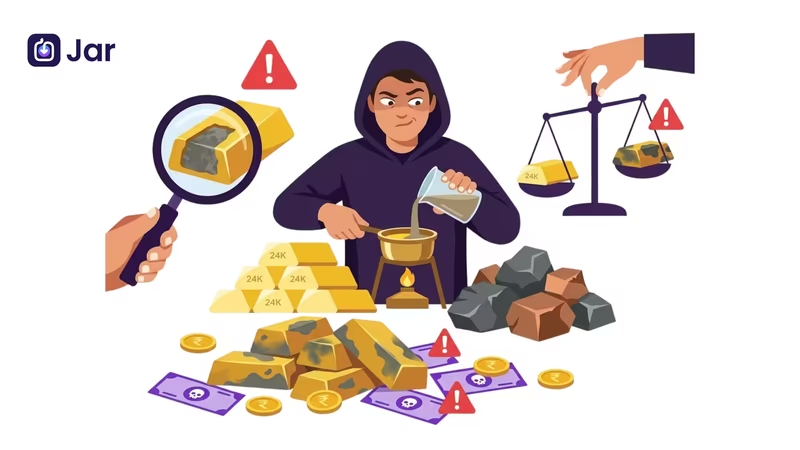


Imagine buying a gold bangle that weighs exactly what the bill says. It passes the acid test, and the jeweller calls it 22K. Weeks later, a goldsmith melts it and finds far less gold than expected.
That's the problem traders are worried about right now. Reports describe suppliers mixing fine heavy-metal powders into gold to add weight. Standard tests often miss them. Here's how the trick works, what happened in the reported cases, and what you can do.
Key Highlights
- Heavy-metal powders such as rhenium can add weight to gold without changing its colour.
- In a reported Jodhpur test, a 22K ornament that was hallmarked as 22K contained about 81.73% gold, roughly 20 carat.
- Acid and touchstone tests mostly check the surface, so they can miss a fake core.
- XRF and fire assay can reveal foreign metals, but they aren't available at every counter.
- Checking the BIS HUID, buying from reliable sellers, and keeping your bill are your best defences.
From Copper Mixing to Heavy-Metal Engineering: The New Anatomy of Gold Fraud
Mixing cheaper metals into gold isn't new. Copper and silver have been used for years. The difference is that those metals change how gold looks and feels, so they're easier to catch.
What Actually Happened: The Jodhpur Test and the Indore Warning
This isn't just theory. Two investigations describe how the scam works in practice.
A Dainik Bhaskar investigation, reported by CNBC-TV18, contacted an agent in Shenzhen, China. The agent said his company made rhenium powder and had dealers in several Indian cities. He also claimed the powder could be mixed into gold in proportions of up to 25% without standard tests catching it. The reporters obtained a one-gram sample through a Mumbai-based dealer.
They then ran an experiment with a jeweller in Jodhpur. One gram of rhenium was mixed with 7.83 grams of 24-carat gold. The total weight rose to 8.83 grams, and the mixture still tested as 24-carat gold.
The jeweller then made a 22-carat ornament. It was reportedly certified as 22K at a hallmarking centre, but its real gold content was 81.73%, closer to 20 carat. It also passed tests at several showrooms and testing facilities.
The report is careful on one point. These results come from the sample in the investigation. They don't prove that every hallmarking centre or testing machine misses rhenium.
The problem also surfaced from the workshop side. In Indore's Sarafa market, several artisans complained to local traders about suspected adulteration. Mint reports that the Indore Silver, Gold and Jewellery Traders Association called an emergency meeting and told bullion dealers and brokers to check purity more carefully before making deals. Traders say complaints about heavy metals such as ruthenium, iridium and osmium have surfaced over the past two to three years.
The Old Playbook vs. The New Threat: Why Copper and Silver Adulteration Was Easy to Catch
Copper can make gold look redder, and silver can make it look paler. A skilled eye or a basic test could often spot the difference.
Enter Chinese Rhenium, Iridium and Tungsten Powders: The ₹2-Lakh-Per-Kg Cost Arbitrage
These powders are dense, and they can be cheap. Mint reports that the so-called "gold powder" is sold at about 10% below prevailing gold rates. The motive is simple: the scammer pays less for weight than gold costs.
How the "Gold-Clad Heavy Core" Method Artificially Inflates Weight Without Changing Color
In the Jodhpur test, the weight changed, but the colour didn't. Scammers don't need to change how the gold looks to make it heavier.
The Physics of Deception: Why Rhenium and Tungsten Behave Like 24K Gold
Gold is very heavy for its size. That's why scammers use other dense metals.
The Specific Gravity Trap: Matching Gold's 19.32 g/cm³ Density with Tungsten (19.25 g/cm³) and Rhenium (21.02 g/cm³)
Specific gravity compares a material's density with water. Gold is about 19.32 g/cm³. Tungsten is close, at about 19.25 g/cm³. Rhenium is heavier, at about 21.02 g/cm³. A blend of gold and a dense metal can land close to gold's density, so a simple density check may not raise a flag.
Extreme Melting Points (3,180°C+): Why Rhenium Powders Don't Fully Fuse; and How Scammers Hide the Suspended Granules
Rhenium melts at over 3,000°C. Gold melts at about 1,064°C. A typical jewellery workshop may not get hot enough to fully blend the powder. That can leave grains inside the metal.
Why Unhallmarked Bullion, Scrap Gold, and Recycled Jewellery Are the Primary Entry Points
Unhallmarked bullion and scrap have no official check to fall back on, so they carry more risk. Traders say the powder is entering markets through Maharashtra and West Bengal. Its origin hasn't been independently confirmed.
The Testing Blind Spot: 4 Reasons Legacy Purity Checks Are Failing Jewellers and Buyers
Most everyday checks look only at the surface, or measure one rough property. Heavy-metal fraud works around both.
1. Touchstone (Kasauti) & Nitric Acid Tests: Why Testing a 22K Outer Skin Misses an Adulterated Core
A touchstone test rubs gold on a dark stone, and acid is applied to the streak. Both react mainly with the outer metal. If the outside is real gold, the test passes, even if the inside isn't.
2. The Water Displacement (Archimedes) Flaw: How Density-Matched Heavy Metals Spoof Volume-to-Weight Ratios
The water test compares weight in air with weight in water. If the blend's density is close to gold's, the result looks genuine. The test is only as good as the density gap it catches.
3. Standard XRF (X-Ray Fluorescence) Spectrometers: The 10-to-50 Micron Penetration Limit
XRF is a useful tool that identifies metals using X-rays. But it reads only a thin surface layer. A real gold skin over a heavy core can fool it.
4. The Melting & Refining Shock: Why the Scam Only Surfaces When Gold Is Cut, Melted, or Refined
Mint reports that artisans found they recovered far less gold than expected after melting. The fraud often shows up at the workshop, not at the counter.
The "3-Layer Purity Verification Framework" for Modern Gold Buyers
No single test catches everything. Layering checks gives you a better chance.
Layer 1 — Digital Traceability: Verifying the 6-Digit BIS HUID on the BIS Care App (And Checking for Laser-Engraving Tampering)
Hallmarked jewellery carries a 6-digit HUID. You can check it on the BIS Care app or the official BIS website. Look for a clean, sharp engraving. A scratched or re-engraved HUID is a warning sign. Our guide to verify the HUID on BIS Care walks you through the steps. You can also learn to spot fake hallmarks in KDM, 916 and BIS gold explained.
Layer 2 — Acoustic & Ultrasonic Screening: Using Sound-Wave Velocity to Detect Unfused Rhenium Pockets in Bars and Coins
Ultrasonic testing isn't a routine test at most jewellery counters. For larger purchases, ask the seller whether the piece has been tested beyond acid and touchstone. Ask for a fire assay report if the amount is significant.
Layer 3 — Provenance & Buyback Guarantees: Why Source Integrity Beats Post-Purchase Testing
Buy from sellers who issue a proper invoice showing weight, purity, making charges and GST. Ask for a written buyback policy at the same purity. Keep the bill. CNBC-TV18 also advises keeping your purchase bill and GST invoice.
The Buyer's Actionable Playbook: How to Protect Your Gold Investments in 2026
Before you pay, check these warning signs.
4 Red Flags When Buying Physical Gold (Unbilled Discounts, "Exchange Scrap" Deals, and Non-HUID Bullion)
- A price well below market rate.
- No bill, or a vague one.
- Bullion or jewellery without a HUID.
- Pressure to exchange old gold quickly.
Why Gold Exchange & Gold Loan Desks Are Tightening Audits; And What It Means for Your Existing Jewellery
The reports don't say how lenders and exchangers are responding. Before you pledge or exchange gold, ask for a test in front of you and a written weight and purity note. You can compare options in our guide to gold loan rates in India.
The Case for 24K Digital Gold & Sovereign-Backed Formats: Eliminating Physical Adulteration and Assay Risk Entirely
At Jar, digital gold is held in a Brink's vault, so you don't receive a physical object that could be adulterated. That removes the physical-purity risk. You can start saving in digital gold with just ₹10.
Frequently Asked Questions (FAQs)
What is rhenium powder and why is it being used in the gold adulteration scam?
Rhenium is a rare, very dense metal. According to CNBC-TV18's report, it was mixed with gold to add weight, and the mixture still tested as gold in the sample used.
Can a standard XRF karat machine detect rhenium or tungsten inside gold?
Not always. XRF mainly reads the surface layer, so a heavy core can stay hidden. Reports say advanced XRF and electron microscopy may help identify foreign metals, but results depend on how the test is run.
Does BIS Hallmarking with a 6-digit HUID protect against heavy-metal gold adulteration?
Hallmarking gives you an official purity record and a traceable HUID, which is your strongest starting point. But the CNBC-TV18 findings relate to the sample in the investigation and don't prove that every hallmarking centre misses rhenium. A draft CAG report also found gaps in inspections. Keep your bill and always check the HUID.
Is digital gold safer than physical gold against purity scams?
Digital gold removes the risk of a fake physical object, since you don't hold metal to test. It isn't risk-free, though, as it is not regulated. Check custody, insurance, and regulation before you invest.