


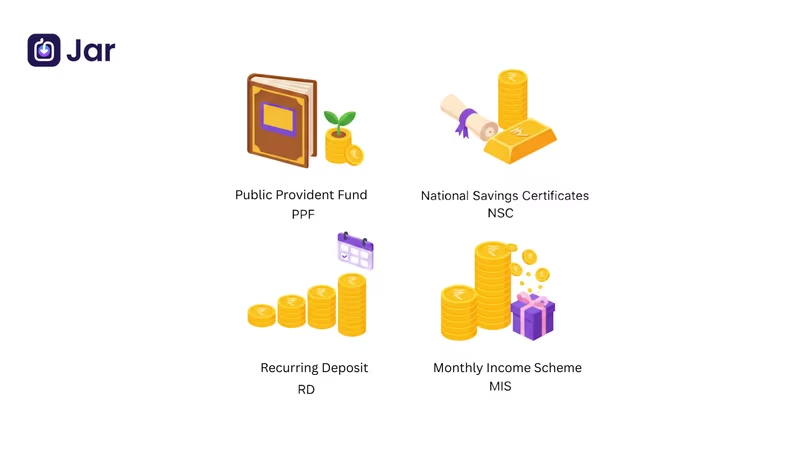


| TL;DR: Government-backed small savings schemes provide structured investing across a range of time horizons, safety, and predictable returns. Here’s a look at the 4 most important ones: - PPF: 15-year tenure, annual deposits up to ₹1.5 lakh, tax-free returns - NSC: 5-year lock-in, lump-sum deposit, fixed interest at purchase - RD: Monthly deposits, usually 5 years, quarterly compounding - POMIS: 5-year tenure, lump-sum deposit, fixed monthly interest payout |
India still relies a lot on government-backed savings, even though mutual funds and digital investments are becoming easier to reach.
According to RBI data, over ₹12 lakh crore is parked in household financial savings through fixed-income instruments, a large portion of which flows into post office schemes.
The reason is simple—these schemes prioritise capital protection, predictable returns, and accessibility.
Indians often use these instruments to protect money meant for education, retirement, or regular income needs.
1-minute guide to small savings schemes
A quick comparison of schemes based on features that matter most:
| Parameter | PPF | NSC | RD | POMIS |
| Tenure | 15 years (extendable in 5-year blocks) | Fixed for 5 years | Usually 5 years | Fixed 5 years |
| Interest | Government-notified, compounded annually | Fixed at purchase, compounded annually | Compounded quarterly | Fixed at investment, paid monthly |
| Deposit type | Annual (₹500-₹1.5 lakh) | One-time lump sum (₹1,000 onwards) | Fixed monthly deposit | One-time lump sum |
| Withdrawal | Partial withdrawal from 7th year; loan from years 3-6 | Premature closure allowed with a penalty | Premature withdrawal after 1 year with a penalty | Fixed for 5 years |
Public Provident Fund (PPF)
PPF is designed for people who can lock in money for the long run.
Tenure: 15 years (extendable in blocks of 5 years)
Investment limits:
- Minimum annual contribution: ₹500
- Maximum annual contribution: ₹1.5 lakh
Returns and liquidity: The interest rate on PPF is set by the government and is added up every year. Interest is paid once a year on March 31.
Some money can be taken out in parts starting in the seventh year, and loans are also an option.
Tax treatment:
- Contributions eligible under Section 80C
- Interest earned: Tax-free
- Maturity amount: Tax-free
PPF is best suited for investors planning long-term goals 10–20 years away.
National Savings Certificate (NSC)
NSC is a fixed-term savings plan backed by the government that gives steady results over a set period of time.
Tenure: Fixed 5 years
Investment limits:
- Minimum investment: ₹1,000
- No maximum investment limit
Returns and liquidity: NSC offers returns based on the national savings certificate interest rate, which is fixed at the time of purchase and compounded annually. The accumulated amount is paid out as a lump sum at maturity.
In terms of liquidity, the scheme does not allow premature withdrawal, except in specific circumstances.
Tax treatment:
- Investment qualifies under Section 80C
- NSC interest is taxable
- Interest deemed reinvested qualifies for deduction (except for the final year).
- Includes NSC tax benefits
It is best suited for medium-term goals with a predictable maturity value (5 years).
Recurring deposit (RD)
A recurring deposit is a monthly savings scheme designed to build money through regular deposits.
Tenure: Commonly 5 years (60 monthly installments)
Investment limits:
- Minimum monthly deposit: ₹100 (can vary by branch)
- No upper limit
Returns and liquidity: In a post office RD scheme, interest is compounded quarterly, and total returns depend on the monthly deposit amount and the chosen tenure.
The scheme allows premature closure, usually with a penalty, and missed installments are permitted, subject to small fines.
Tax treatment:
- Interest fully taxable
- No Section 80C benefit
This option is best suited for short- to medium-term goals over 1-5 years.
Post Office Monthly Income Scheme (POMIS)
It's also sometimes called the POMIS scheme or the post monthly income scheme, which both refer to the fact that it pays out every month.
Tenure: Fixed 5 years
Investment limits:
- Maximum investment (single account): ₹4.5 lakh
- Maximum investment (joint account): ₹9 lakh
Returns and liquidity: The post office monthly income scheme pays interest every month at a rate that was set when the money was invested. This rate is set by the post office monthly income scheme interest rate.
Premature withdrawal is permitted in post office savings schemes after one year with a penalty, and the original capital is returned in full at maturity.
Tax treatment:
In the post office monthly income scheme:
- Interest is taxable
- There is no Section 80C benefit
This post office monthly income scheme is suited for those with regular monthly income needs, such as retirees and dependents.
| Did you know? When comparing FD, RD, SIP, and PPF, the real difference lies in their purpose: - Post office fixed deposit: Predictable returns; interest is fully taxable - Recurring deposit: Monthly savings discipline; post-tax returns are modest - Systematic investment plan: Market-linked, growth potential, returns can fluctuate - Public provident fund: Long-term, tax-efficient savings |
How to choose the right scheme
Use these simple questions to narrow your choice:
- Choose PPF when you need the money after 10+ years and want strong tax efficiency.
- Choose NSC when you have a fixed 5-year goal and want predictable returns with tax planning.
- Choose RD when you want to save small amounts regularly for a short- to medium-term goal.
- Choose MIS when you need a steady monthly income from a lump sum.
Making small savings work for you
Small savings schemes work best when you can commit time or lump sums. For many savers, the first challenge is simply starting.
Micro-savings solve that gap. Saving small amounts regularly, especially in evergreen commodities like gold, helps build consistency before moving into long-term schemes.
Start small with Jar: Buy 24K gold in under a minute on the Jar app and turn everyday savings into a habit.
FAQS on small savings schemes
1. How often do interest rates on small savings schemes change?
Every three months, the government looks at interest rates and lets people know what they are. When you put in plans like PPF, NSC, or MIS, on the other hand, the rate stays the same for the length of your investment.
2. What happens if I forget to deposit money in PPF or RD for a year or a month?
PPF accounts can become inactive if the minimum yearly contribution isn’t made, but they can be revived with a small penalty. In RDs, missed installments attract minor fines.
3. Is it possible to move money from one scheme to another?
Direct transfers aren’t allowed. Funds must be withdrawn at maturity or as permitted and then reinvested into another scheme.