



Ever wondered how a gold chain on a jeweller's shelf in Bengaluru started life as rock deep underground, possibly on another continent? That journey is the gold supply chain, and it explains why gold prices behave the way they do.
Here is one number to start with. Mines typically provide about 75% of the world's gold supply each year, and recycling covers most of the rest. That split, plus India's heavy reliance on imports, shapes what you pay at the counter.
In this guide, you'll learn how gold moves from mine to market, who handles it at each step, and how costs build up along the way. You'll also see how India's gold import rules work, including the big duty change of May 2026.
What Is the Gold Supply Chain?
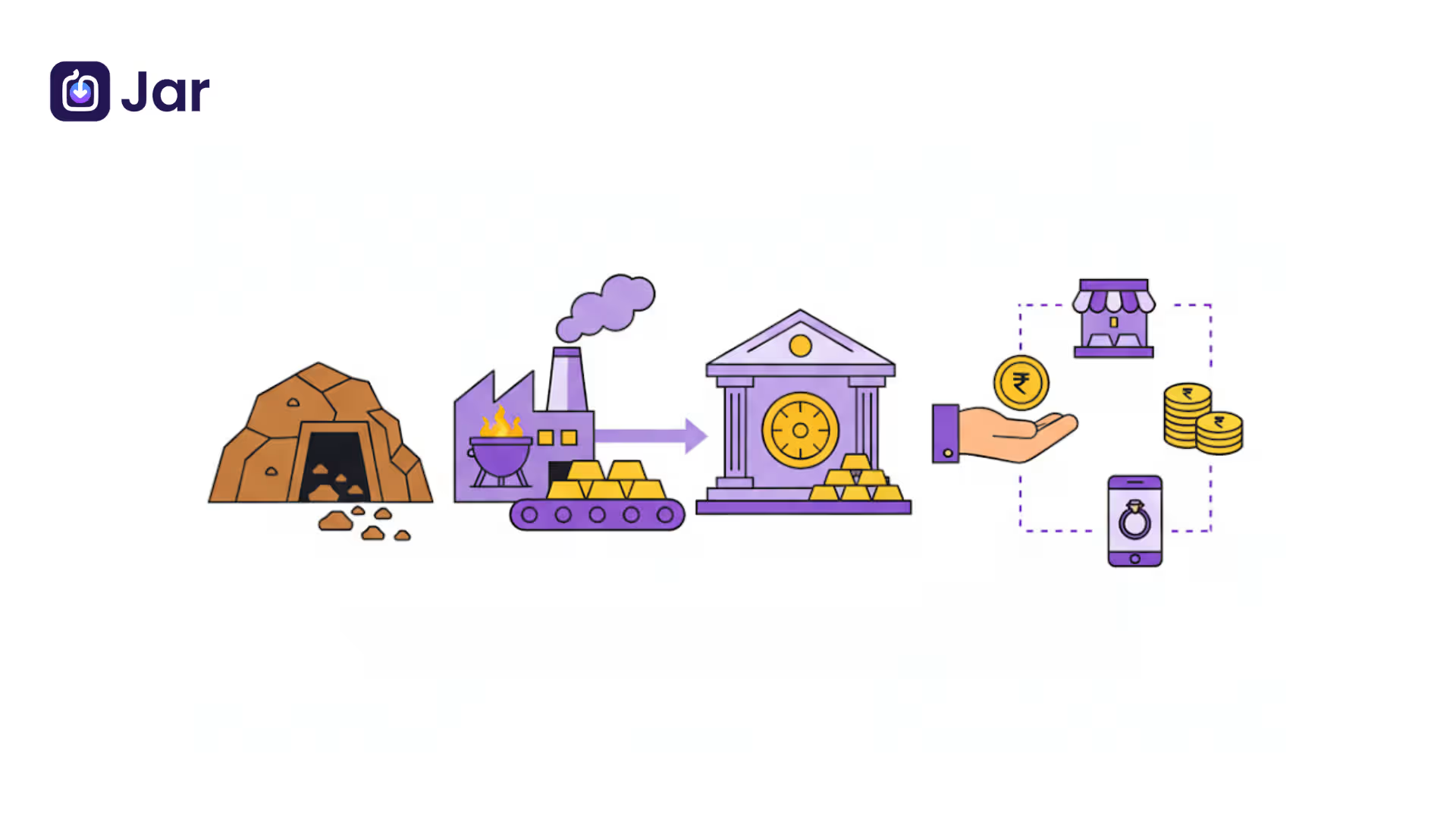
The gold supply chain is the full route gold takes from the ground to the final user. It covers exploration, mining, processing, refining, transport, trading, and finally jewellery, bars, coins or electronics.
Industry writers split it into two halves. Everything up to the smelter is called "upstream" (mining and early trading). Everything after is "downstream" (refining, minting, dealing and retail).
One feature makes gold unusual: it almost never disappears. Because gold is so durable, nearly all the gold ever mined still exists in some form and can be recycled. So the chain is partly a loop, not a straight line.
Gold Supply Chain at a Glance: Stages, Players and India Gold Import
| Stage | What happens | Who is involved |
| Permits & exploration | Government approval, geological surveys | Mining firms, regulators |
| Mining | Open-pit, underground or placer extraction | Large-scale and small-scale miners |
| Initial processing | Crushing, concentration, smelting into doré | Mine processing plants |
| Trading & transport | Gold moves via local traders, exporters, secure logistics | Traders, logistics firms |
| Refining | Purified to 99.5%–99.99% | Refineries |
| Minting & fabrication | Bars, coins, blanks, jewellery | Mints, manufacturers |
| Distribution | Banks, exchanges, dealers, jewellers | Banks, bullion dealers, retailers |
| Recycling | Old jewellery and electronics re-enter the chain | Refiners, collectors |
| India gold import | Imported through authorised channels, then duty applied | Banks, nominated agencies, IIBX-linked jewellers |
How the Gold Supply Chain Works, Step by Step
Step 1: Permits and exploration
Before anyone digs, a company needs government permission. Rules cover worker safety, environmental impact and land rights, and they differ from country to country.
They can also change with the political climate.
Geological surveys come first, and it can take several years to build the infrastructure for a new mine. This is why mine output reacts slowly when gold prices move.
Step 2: Mining
There are three common ways to extract gold:
- Open-pit mining: Large pits are dug to reach deposits near the surface. It is efficient for big volumes but can heavily affect the environment.
- Underground mining: Tunnels reach deeper deposits. It costs more and is more complex.
- Placer mining: Gold particles are recovered from riverbeds and streams. It is usually gentler on the land but less productive.
Miners also fall into two groups. Large-scale mining (LSM) uses heavy machinery. Artisanal and small-scale mining (ASM) is done by smaller, often informal operators.
One trade source estimates ASM supplies roughly a fifth of mined gold and employs far more people than industrial mining. Yields are small, too: a ton of ore may hold only one to twenty grams of gold.
Step 3: Crushing, concentrating and smelting
Raw ore is crushed, then ground into fine powder. Next comes concentration, which separates gold from other material. Two common methods are gravity separation, which uses density differences, and flotation, where gold clings to air bubbles in a chemical slurry.
The concentrate is then smelted, meaning it is heated until the gold melts. The molten metal is poured into doré bars. These are semi-pure bars that still contain silver, copper and other metals, so they need refining.
Step 4: Local traders, exporters and transport
Between the mine and the refinery there may be one step or many. A small miner might sell to a local trader, who sells to a bigger trader, who sends it on to a smelter or refinery. Large miners can skip these middle steps.
Transport adds cost, whether it is a truck, a flight or an armoured van. Secure logistics firms, insurance and customs clearance all feature, because gold is high-value and travels across borders.
Step 5: Refining and assaying
Refineries purify doré to market grade. Two classic methods are:
- Miller process: Chlorine gas is blown through molten gold. It is fast and cost-effective, reaching about 99.5% purity.
- Wohlwill process: Electrolysis lifts purity to as high as 99.99%. It is slower and costlier, but gives the finest result.
Purity is then confirmed through assaying, which measures how much pure gold is in a sample. Refiners also check weight and paperwork before gold enters major markets. Refined metal is cast into bars, or into "blanks" that mints use to strike coins.
Step 6: Mints, bars and jewellery
Mints turn refined gold into coins and bars. Manufacturers use it for jewellery. Central banks hold gold bars as reserves, and the technology sector uses gold in electronics and medical devices because it conducts well and resists corrosion.
Step 7: Banks, exchanges, dealers and you
Refined gold then flows to banks, vaults, exchanges, dealers and jewellers. Trading happens both physically (bars, coins, jewellery) and electronically. Prices move with currencies, interest rates, investor demand and geopolitical events. Which brings us to a second source of supply.
Recycled Gold: The Second Supply Line
Mines can't meet all demand, so recycling fills the gap. The World Gold Council says recycling responds fastest to price changes and economic shocks. At least 90% of recycled gold comes from jewellery, and the rest from technology.
For Indian families, this will sound familiar: old jewellery gets exchanged, melted and refined into new pieces. In supply-chain terms, that is the loop closing.
Where the Money Goes: How Costs Stack Up
When you buy gold, you pay for the metal and for the journey behind it. One wholesale dealer, GSI Exchange, estimates how markups build up along the way. Treat these as illustrative US-market figures, not Indian rates.
| Stage | Estimated markup (GSI Exchange) |
| Local traders and exporters | around 2% |
| Transport | around 1.5% |
| Smelting and refining (bars) | around 1.5% more |
| Mint (coins and bars) | 5% to 15% |
Dealers then add their own costs for insurance, quality checks and operations. The takeaway is simple. Every extra hand in the chain adds cost, which is why shorter, more transparent chains are good for buyers.
India Gold Import: Where India Fits In
Why India depends on imports
India is the world's second-largest gold consumer, and jewellery drives most of that demand. Domestic mining and recycling cannot cover it all, so India relies heavily on imports.
In FY26, India's gold and silver imports were worth $84 billion, about 10.8% of all merchandise imports. In early 2026, average monthly gold imports rose to 83 tonnes, up from 53 tonnes a month in 2025.
Who is allowed to import
Gold doesn't enter India freely. Only authorised banks and nominated agencies may import it.
Rules tightened further in 2025:
imports of many gold forms are restricted to RBI-nominated banks, DGFT-approved entities, qualified jewellers linked to the India International Bullion Exchange (IIBX), and traders with valid India-UAE FTA quota.
This is a key part of India gold import regulation, and a gap in most global explainers.
Where India's gold comes from
Switzerland and the UAE are the two biggest suppliers, with South Africa also prominent. Switzerland isn't a major miner. It is a refining hub where gold mined elsewhere is purified and converted into bullion.
So Swiss-origin gold is usually globally mined gold.
The UAE rose sharply after the India-UAE trade pact. Under CEPA, a quota system allows UAE gold in at a tariff one percentage point lower, and Dubai's share of India's gold imports rose from 7.9% to 28% in 2025.
Mining countries also ship unrefined doré, while financial hubs ship refined bars. Ghana, Peru and Chile are among doré suppliers, while the UAE, Switzerland and the UK ship refined bars.
The 2026 import duty
This is the biggest change for India gold import in years. India raised import duties on gold and silver from 6% to 15%, made up of a 10% basic customs duty and a 5% cess. The change followed currency and import-bill concerns, and the new rates applied from 13 May 2026. It reverses the July 2024 cut that had brought duty down to 6%.
What the 2026 Duty Hike Means for Buyers
Higher prices. Duty is built into the price before GST. One estimate puts the combined effect of 15% duty plus 3% GST on the duty-loaded value at roughly 18.45%, before making charges. Prices rose by less than the full nine points at first, because jewellers still held stock bought at the old rate.
Softer demand. The World Gold Council projects the hike could cut India's 2026 jewellery and bar-and-coin demand by 50 to 60 tonnes, roughly 10% year on year.
What you can do:
- Compare the live price with your jeweller's quoted rate and ask how the duty is reflected.
- Check making charges separately, since they sit on top of the gold price.
- Insist on a BIS hallmark for purity assurance.
- Consider whether you need physical gold at all, or whether a paper or digital route suits your goal better.
This is general information, not financial advice. For investment decisions, speak to a qualified advisor.
Responsible Sourcing and Traceability
The chain has ethical risks too. Mining affects land and water, and safety conditions vary. Certification schemes such as Fairmined exist to help production benefit local communities.
Industry writers also say the sector is moving towards greater transparency, sustainability and documentation of where gold comes from. If you buy from a large jeweller or bank, ask about sourcing policies.
Conclusion
The gold supply chain links miners, traders, refiners, mints, banks, jewellers and recyclers across the world. Understanding it explains why gold prices move, why purity matters and why every extra step adds cost. For Indian buyers, the India gold import layer is the part that most affects what you pay, and the 2026 duty change shows how fast it can shift. Next time you shop for gold, ask where it comes from and what the price includes.
FAQs
What is the gold supply chain in simple words?
It is the journey gold takes from mine to consumer: mining, processing, refining, trading, manufacturing and retail, with recycling feeding back in.
How much gold comes from mines versus recycling?
Mine production typically accounts for about 75% of annual supply. Recycling makes up much of the rest.
What is a doré bar?
A semi-pure bar poured at the mine after smelting. It contains gold plus silver, copper and other metals, and goes to a refinery for purification.
Who can handle India gold import?
Authorised banks, nominated agencies and entities approved under rules from the RBI, DGFT and IIBX. Individuals can't import commercial quantities freely.
What is the current gold import duty in India?
Since 13 May 2026, it is 15% (10% basic customs duty plus 5% cess), raised from 6%. Check the latest official notification before any transaction, as rates can change.