

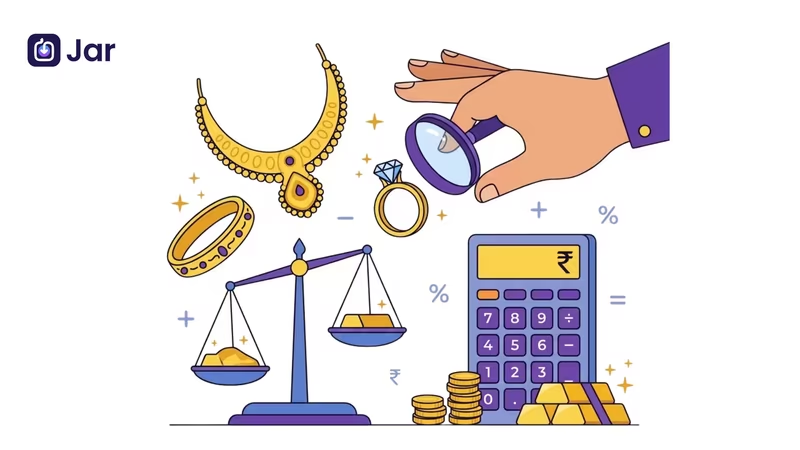


Got old gold sitting in a locker? You might wonder what it's worth, or whether it's worth exchanging for something new. The jeweller's quote often comes in lower than you expected. The gold rate you saw online doesn't match either.
This guide shows you how to estimate the resale value yourself before you walk in. You'll get the formula, a couple of worked examples, and a list of the deductions that shrink the payout.
Key Highlights
- Resale value is roughly net gold weight × purity × today's 24K buyback rate, minus deductions.
- Only the gold counts. Stones, kundan, lac, wax, and enamel add weight but usually add no value.
- 22K gold is about 91.6% pure and 18K is 75% pure, so the purity stamp changes your payout a lot.
- Jewellers pay a buyback rate, which is usually lower than the retail rate on the shop board.
- Making charges and the GST you paid at purchase generally don't come back when you sell.
Quick Answer: The Exact Formula to Calculate Old Gold Jewellery Resale Value
Multiply the net gold weight by the purity and by today's 24K buyback rate per gram. Then subtract the jeweller's deductions. That's your estimated payout.
The 10-Second Net Resale Value Formula (Exchange vs. Cash Payout)
Net Resale Value = (Net Gold Weight × Purity Fraction × 24K Rate per Gram) − Deductions
- Net gold weight: the grams of gold alone, with stones and other non-gold parts removed.
- Purity fraction: 0.916 for 22K, 0.750 for 18K.
- 24K rate per gram: today's buyback rate, not the retail display rate.
- Deductions: melting loss (wastage) and other shop charges.
With an exchange, the jeweller usually credits this amount toward new jewellery. With a cash sale, you get the money, though the rate and deductions may differ.
Quick Reference Table: Karat-to-Fineness Conversion (24K, 22K, 18K, and 14K)
| Karat | Fineness Mark | Pure Gold Share |
| 24K | 999 | About 99.9% |
| 22K | 916 | 91.60% |
| 18K | 750 | 75% |
| 14K | 585 | 58.50% |
Not sure which karat suits you? Read 24K vs 22K vs 18K gold for a fuller comparison.
How to Calculate the Value of Your Gold Jewellery at Home in 5 Steps
You can estimate most of the value at home. Work through these steps in order, and you'll know roughly what to expect before you visit a shop.
Step 1: Identify Your Gold's Purity at Home (Reading 916/750 Stamps, Hallmarks & BIS Care App Check)
Check the clasp, the inside of a ring band, or the back of a pendant for a stamp. 916 means 22K. 750 means 18K. A BIS hallmark with a six-digit HUID code means the piece was tested and certified. You can check that code on the BIS Care app. If the marks look unclear, read about KDM vs 916 vs BIS hallmark. You can also see how to check gold purity at home.
Step 2: Measure the Net Gold Weight (Subtracting Stones, Kundan, Lac/Wax, and Enamel from Gross Weight)
Weigh the whole piece first. That's your gross weight. Next, remove the stones, kundan, lac or wax filling, and enamel. What's left is the net gold weight, and it's the number that drives the price. If you take out the stones yourself, the jeweller doesn't have to estimate their weight.
Step 3: Check Today's Benchmark Gold Rate in India (Why Retail Display Rates Differ from IBJA Buyback Rates)
Use today's 24K rate from a benchmark such as IBJA. Retail display rates include the shop's margins and other costs, so they usually run higher than the buyback rate. The IBJA rate vs jeweller rate explainer covers this gap in detail.
Step 4: Calculate the Gross Metal Value (Net Gold Weight × Purity % × 24K Rate per Gram)
Multiply the net weight by the purity fraction, then by the 24K rate. Take 10 grams of 22K gold at an assumed 24K rate of ₹7,000 per gram:
10 × 0.916 × ₹7,000 = ₹64,120
The ₹7,000 rate is only an assumption for this example. Use the actual rate on the day you check.
Step 5: Subtract Jeweller Melting Charges, Wastage, and Cash-Buyback Deductions
After testing, the jeweller deducts melting loss, often called wastage. The percentage depends on the shop and how the gold was tested. Unhallmarked or older pieces usually face bigger deductions. Subtract that amount from your gross value. What's left is your realistic estimate.
To simplify the process, you can also use our Gold value resale calculator.
Real-World Examples: Calculating Old Gold Resale Price in Rupees (₹)
These examples are fictional. The ₹7,000 rate and the deduction percentages are assumed for illustration.
Example 1: Selling 10 Grams of Plain 22K (916) BIS-Hallmarked Gold Jewellery
Priya has a plain 22K bangle. It weighs 10 grams, has a 916 mark, and carries a six-digit HUID. Let's assume a 2% melting deduction.
- Gross metal value: 10 × 0.916 × ₹7,000 = ₹64,120
- Melting deduction at 2%: ₹1,282
- Estimated payout: ₹62,838
Priya keeps most of the value because the bangle is plain and certified.
Example 2: Selling 15 Grams of Studded 18K or Unhallmarked Ancestral Jewellery (With Stone & Melting Deductions)
Rahul has an 18K necklace that weighs 15 grams. It has kundan stones and no hallmark. After he removes about 3 grams of stones and lac, the net gold weight is 12 grams. Assume a 5% deduction for the missing hallmark.
- Gross metal value: 12 × 0.750 × ₹7,000 = ₹63,000
- Deduction at 5%: ₹3,150
- Estimated payout: ₹59,850
Rahul's necklace weighs 15 grams, but the shop pays for 12. The stones and lac add weight, not value.
Why Your Gold Jewellery Selling Price Is Always Lower Than Your Purchase Price
Your payout is usually lower than what you paid. Part of your purchase price covered design, craftsmanship, and tax. None of that comes back when you sell.
The Sunk Cost Trap: Losing 8% to 25% in Making Charges and 3% Purchase GST Instantly
Making charges pay for design and labour. They vary by piece, and they're generally not refunded at resale. The GST you paid on the jewellery isn't refunded either. To see how making charges are built up, read about how making charges are calculated. For GST rules on exchanges, see GST on old gold exchange.
The Buy-Sell Spread: Why Jewellers Buy Old Gold 1% to 3% Below the Daily Retail Selling Rate
Jewellers sell new gold at a higher rate than they buy old gold. The gap covers their margin, handling, and risk. It changes from shop to shop and city to city. Ask for the buyback rate in writing before you agree.
Solder (Tanka) vs. 6-Digit HUID: Why Pre-2021 Ornaments Face Higher Purity Haircuts
Some older ornaments were joined with solder, called tanka. Solder isn't pure gold, so it lowers the purity a jeweller can credit. Six-digit HUID codes became mandatory on hallmarked jewellery from 2021. Pieces with a clear HUID are easier to verify, so they often face fewer haircuts.
Zero-Resale Components: Semi-Precious Stones, Meenakari Work, and Hollow Wax Fillings
Stones, kundan, and enamel don't count as gold. Hollow pieces filled with wax or lac add weight but no gold. Remove what you can and weigh it separately. Expect little or no value for the rest.
Key Factors That Influence Your Final Gold Resale Payout in India
The formula is only part of the story. Where you sell, how you sell, and how the gold is tested all change the final number.
Old Gold Exchange vs. Instant Cash Liquidation: The 2% to 4% Payout Difference
Exchanging for new jewellery often gets a better rate than cash selling. Cash is quicker, though. If you're upgrading anyway, the exchange may leave you with more value. If you need money today, speed may matter more. Compare both offers before you decide.
Where You Sell Matters: Original Brand Jeweller vs. Another Chain vs. Cash-for-Gold Buyers (Comparison Table)
| Where you sell | What to expect | Best for |
| Original brand jeweller (with bill) | Often a fair exchange rate and clear deductions | Hallmarked pieces bought there |
| Another organised chain | Rate may differ, and it may re-test your gold | Comparing quotes |
| Cash-for-gold buyer | Fast cash, but deductions can be less transparent | Urgent cash needs |
Purity Testing Method: Non-Destructive XRF Karatmeter vs. Melting (Fire Assay)
An XRF karatmeter reads purity without damaging the piece. Melting, or fire assay, is the most precise method, but the piece is gone afterwards. Ask for an XRF reading first. Agree to melting only if the reading is unclear and you're sure you want to sell.
Tax Impact on Selling Physical Gold: STCG & LTCG Rules (12.5% Long-Term Capital Gains Tax)
Tax applies to your profit, not the full sale value. Under the current rules, gold held for 24 months or less is short-term, and the gain is taxed at your income tax slab rate. Gold held for longer is long-term, and the gain is taxed at 12.5% without indexation. Tax rules change, so check the Income Tax Department website or ask a tax adviser before you file.
The "3-Tier Gold Recovery Rule": How to Maximise Your Payout & Avoid Resale Losses
Not all gold recovers the same share of its value. This rule groups common cases into three tiers. The percentages in the headings are rough estimates, not guarantees. Your payout depends on the shop, the test, and that day's rate.
Tier 1 (98%–100% Gold Value Recovery): Exchanging BIS HUID 22K Gold at the Same Jeweller with an Invoice
This is usually the easiest case. The purity is clear, the piece is certified, and the invoice shows where it came from. You'll likely see the fewest deductions.
Tier 2 (92%–96% Gold Value Recovery): Selling Hallmarked Gold for Cash or Without the Original Bill
Hallmarked gold still sells well. Cash sales and missing bills can add a small haircut, though. Keep the HUID details handy so the jeweller can confirm the purity quickly.
Tier 3 (70%–85% Gold Value Recovery): Selling Heavy Kundan, Polki, or Unhallmarked Broken Jewellery
Heavy stones, unclear purity, and damage all lower the offer. A broken piece still counts by weight, but expect more testing and bigger deductions.
Physical Jewellery vs. 24K Digital Gold: How to Get 99.5% Purity Resale Without Making-Charge Losses
Physical jewellery comes with making charges and purity checks. Digital gold is bought as 24K gold, which is about 99.9% pure, and it doesn't carry making charges. GST may still apply, so check the terms. If you're weighing the two, read about the benefits of digital gold and compare costs and risks. On Jar you can buy digital gold starting at ₹10.
Frequently Asked Questions (FAQs)
Do I get the same gold rate shown online when selling jewellery?
Usually not. Online and retail rates include the seller's margin. Jewellers pay a buyback rate, which is often lower. Ask for the buyback rate in writing before you agree to the sale.
Can I calculate the value of my gold jewellery at home?
Yes, you can get a close estimate. You need the net gold weight, the purity, and today's 24K rate, and use the gold resale value calculator to find the resale value of your old gold. The final offer can still differ after the jeweller tests the gold.
Why does 22K jewellery fetch less resale value than 24K?
22K gold is about 91.6% pure. The rest is copper, silver, or zinc, which the shop doesn't pay gold rates for. 24K is about 99.9% pure, so it has more gold to pay for.
How does the BIS 6-digit HUID hallmark affect the gold resale price?
A HUID shows the purity was tested and certified. Certified gold usually needs less testing, so it often faces fewer deductions. Unhallmarked gold may face extra testing and a bigger cut.
Can I sell broken or damaged gold jewellery?
Yes. The shop usually values broken pieces by net gold weight and purity. Damage can make testing harder, so expect a larger deduction. Keep every part, even small broken bits.
Why do jewellers deduct charges when buying back old gold?
Melting and refining lose some metal, and testing takes time and cost. Stones, enamel, and solder also reduce the pure gold the shop can count. Ask for the deduction in writing so you can compare offers.
Is GST charged again when selling or exchanging old gold jewellery?
When you sell old gold for cash, you usually don't pay GST on the sale. On an exchange, GST applies to the new jewellery you buy, and the value of your old gold comes off the bill. Check how your invoice shows this.
Can I sell old gold jewellery without the original purchase bill?
Yes, but the offer may be lower. Without a bill, the jeweller can't confirm where the piece came from, so they may apply extra checks or deductions. A HUID-hallmarked piece is easier to value.
Is 24K digital gold resale better than physical gold jewellery resale?
It depends on what you want. Digital gold is bought as 24K gold with no making charges, so you lose less to design costs. Jewellery makes more sense if you plan to wear it. Compare costs, taxes, and how quickly you can sell before you decide.