


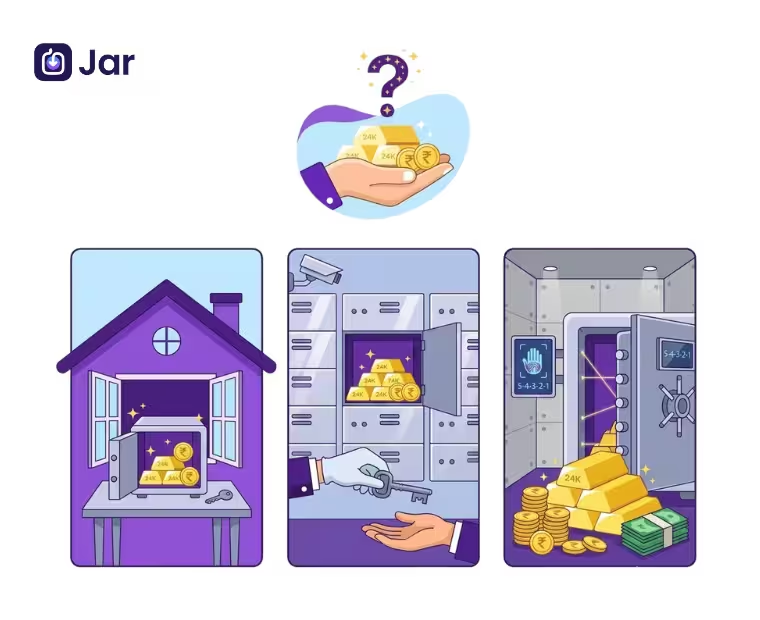


Key Highlights
- Home safes let you access your gold anytime, but shift most of the security risk to you and require strong insurance.
- Bank lockers offer institutional security at low cost (₹1,500–₹5,000 yearly), but banks don't insure contents and compensation is capped at 100 times your annual rent.
- Private vaults provide professional security and insurance, but cost more (usually 0.5–1% of your gold's value annually) and may be far from your home.
- Storing gold safely isn't just about theft—fire, flood, and insurance gaps matter just as much.
- The "safest" option depends on how much gold you have, how often you need it, and whether your insurance actually covers it.
If you own gold—whether it's jewelry you wear, family heirlooms, or investment bars—you face a real problem: where do you keep it safe?
Gold is valuable and portable. It's easy to steal. It's hard to replace if something goes wrong. And if you don't store it properly, you could lose money not just to theft, but also to fire, flood, or your insurance refusing to pay a claim.
The good news is you have options. But each one works differently and carries different risks.
In this article, you'll learn how to store gold in three different ways—at home, in a bank locker, and in a professional vault. You'll understand the real trade-offs, what insurance actually covers, and which option makes sense for your situation.
Option 1: Storing Gold at Home
Keeping gold at home means you're responsible for securing it yourself. This works well for some situations, but carries real risks if you're not careful.
Pros: Immediate Access and No Recurring Fees
You can reach your gold anytime. If you wear jewelry regularly, need emergency cash, or want to gift gold during a festival, home storage makes sense. You don't pay annual locker rent. The main cost is a good safe and insurance.
A decent fire-resistant safe costs between ₹5,000 and ₹30,000. For serious bullion holdings, you might spend more.
Cons: High Theft Risk and Insurance Limitations
Here's the hard truth: if your safe isn't properly installed, a thief can carry it away. If your neighbors, staff, or visitors know you have gold, they become a risk. Insurance companies limit jewelry coverage. Many home policies won't cover undeclared items, or they cap what they'll pay per piece.
Fire doesn't destroy gold, but it can damage documents proving what you own, making insurance claims harder to prove.
Essential Tips for Installing a Home Safe
If you decide to store gold at home, do it right:
Choose a burglary-rated safe, not just a fireproof box. Look for ratings like UL TL-15 or TL-30. These mean the safe resists professional tools for 15 or 30 minutes. A basic fireproof box won't stop a determined thief.
Bolt it down properly. Use the manufacturer's anchors and bolt your safe to concrete or a solid wall. An unanchored safe can be moved, even if it's heavy.
Keep it hidden but accessible. Don't put it in an obvious bedroom closet. Choose a less predictable spot, but make sure you can reach it in an emergency.
Add layers of security. Use an alarm system. Add CCTV if lawful and practical in your area. Keep strong locks on doors. Don't tell people you have gold at home.
Get proper insurance and document everything. Declare your gold with your insurance company. Keep receipts, photos, valuation certificates, and hallmark details. When you make a claim, the insurer will pay the lower of what you claimed or what the gold's worth.
Keep an inventory elsewhere. Store copies of receipts, photos, and serial numbers in encrypted cloud storage or with a trusted person. If theft happens, you'll need proof of what you owned.
Spread the risk. Don't keep all your gold in one place. Keep everyday jewelry at home, valuable pieces in a bank locker, and bullion elsewhere.
Option 2: Bank Lockers / Safe Deposit Boxes
A bank locker gives you institutional security at a low price. But there's a catch: the bank doesn't insure what's inside.
Pros: Institutional-Grade Security & Affordability
Banks have surveillance, controlled access, and secure buildings. You get a record of every time someone opens your locker. Rent is cheap—usually ₹1,500 to ₹5,000 per year in India, depending on the bank and locker size.
How to keep gold in a bank locker: Most banks let you access your locker during business hours on working days. You need to sign an access register each time. When you die, if you've named someone as a nominee, they can take out the contents without going through long legal processes.
Cons: Banking Hours, Limited Access & Hidden Fine Print
You can only access your locker when the bank is open on working days. If you need gold for a festival that falls on a weekend, you're out of luck.
If there's a flood, riot, curfew, or lockout, the bank can legally refuse to let you in. You can't access your locker during these events.
Getting a locker can be hard if your branch is busy. You might have to wait or use a branch far from home.
The bank requires you to pay rent in advance and follow their rules about how often you can access the locker.
The Truth About Bank Liability and Insurance Caps
Here's the part banks don't advertise loudly: banks do not insure your locker contents. This is a rule set by the Reserve Bank of India. The bank provides secure space. That's all.
The bank is liable for loss only if the bank's negligence caused it. This includes theft, burglary, fire, building collapse, or employee fraud. But even then, there's a cap: the bank will pay a maximum of 100 times your annual locker rent.
If you pay ₹3,000 annually, the cap is ₹3 lakh. If you pay ₹4,000, it's ₹4 lakh.
Think about this: if you're storing ₹10 lakh of gold in that locker, and it gets stolen, the bank pays only ₹4 lakh. You lose ₹6 lakh.
The bank also isn't liable for losses from natural disasters—earthquakes, floods, and lightning don't count. The bank won't help if you were careless with your own keys either.
The bank doesn't keep records of what's inside your locker. So if something goes missing, you have to prove what was there. No documentation means no claim.
The practical takeaway: A bank locker is secure storage, not insurance. If you want real protection, buy a separate jewelry or valuables insurance policy. Some home insurance products cover jewelry kept in recognized bank lockers, but check the terms, limits, and exclusions carefully.
Option 3: Professional Private Vaults
Private vaults are designed specifically for valuables. They're more expensive than bank lockers, but they include insurance and professional oversight.
Pros: Segregated Storage, Full Insurance, and 24/7 Monitoring
Private vaults use specialized security designed for high-value items. Your gold is stored separately and identified as yours. Insurance usually comes with the service—something banks don't offer.
Access is often more flexible. Some providers let you book appointments outside normal banking hours. Some offer delivery or redemption options. Digital gold providers, for example, often include comprehensive vault insurance plus transit insurance.
If your gold is stored in a segregated vault, it's yours alone, not mixed with others' holdings. This matters for ownership and audit rights.
Cons: Higher Annual Fees & Geographic Distance
Vault storage typically costs 0.5% to 1% of your gold's value per year. For ₹10 lakh in gold, that's ₹5,000 to ₹10,000 annually. This adds up over time.
You might have to travel to access your gold. If you live far from a major city, this is inconvenient.
You're trusting a private company. You need to research the operator, understand their insurance, check their redemption process, and know what happens if they go out of business. Some services use pooled vaults, meaning your gold is mixed with others'—different from segregated storage.
Withdrawing gold involves fees, authentication, making charges, and transit time. It's slower and more expensive than walking into a bank and opening a locker.
Detailed Comparison: Security, Cost, Access, and Risk
| Factor | Home Safe | Bank Locker | Private Vault |
| Security Model | Your safe, locks, alarm, and discretion | Bank building, controlled access, surveillance, access register | Specialist operator, professional security, monitoring, insurance included |
| Access | Immediate, 24/7 | Bank working hours only; can be disrupted by floods, riots, curfews | Appointment-based; extended hours possible; delivery/redemption options |
| Typical Cost | One-time safe cost (₹5,000–₹30,000+); insurance extra | Usually ₹1,500–₹5,000 per year | Usually 0.5–1% of gold value annually |
| Insurance | You arrange and declare; sub-limits and exclusions apply | Bank doesn't insure; you need separate policy | Often bundled or arranged by provider |
| Liability & Risk | You bear most risk unless insurance pays | Liability only in negligence-related cases, capped at 100x annual rent | Governed by vault agreement; check negligence and force majeure terms |
| Natural Disasters | Depends on safe rating and location | Bank not liable for acts of God | Depends on contract and insurance |
| Best For | Frequently used jewelry, small holdings, emergency access | Moderate-value jewelry, documents, low-cost long-term storage | High-value bullion, investment gold, larger holdings, insurance priority |
| Main Weakness | Theft if poorly secured, insurance gaps | Limited access, compensation cap far below gold value | Cost, location, provider research required |
Which Gold Storage Option Works Best for You?
The right choice depends on what you're storing and why.
Best for Small Personal Holdings & Everyday Jewelry
Home storage makes sense when:
- The value is small compared to your total wealth.
- You wear the jewelry often.
- You have a burglary-rated safe, properly anchored.
- You have declared, adequate insurance.
- You maintain invoices, photos, valuations, and an inventory.
Many households use a hybrid approach: keep daily-wear jewelry at home in a secured safe, place valuable or rarely-worn pieces in a bank locker.
Best for High-Value Investors and Bullion
Private vault storage is usually better when:
- You hold significant bars, coins, or investment-grade gold.
- Insurance against theft, fire, and transit is a priority.
- You want professional custody instead of relying on home security.
- You may want periodic audits, allocation confirmation, or withdrawal services.
- You can accept an ongoing percentage-based fee.
Bank lockers are a reasonable middle option for moderate-value holdings. Just remember: the 100x annual rent cap can be far below what your gold is actually worth.
Key Takeaways
Storing gold safely means more than just preventing theft. It means protecting against fire, flood, theft, staff fraud, and insurance failure.
Home storage gives you control and access, but transfers most risk to you. Bank lockers offer low-cost institutional security, but limited access and weak insurance. Private vaults provide professional custody and insurance, but at a higher cost.
"Safest" doesn't mean one size fits all. It means the lowest probability of losing money, considering your specific situation.
Declare your gold with your insurance company. Maintain documentation. Diversify storage—don't keep everything in one place. Check the fine print. Understand what's actually covered.
If you're considering digital gold as part of your overall strategy, platforms like Jar let you hold gold without managing physical storage, combining accessibility with professional custody. Evaluate all three—home, bank, and vault—based on your gold's value and your needs.
Jar lets you save in gold daily, weekly, or monthly with autopay so you don't forget to save. You can also choose the round-off feature, which rounds each transaction to the nearest 10. Download the Jar app and start saving in Digital Gold at your convenience.
Frequently Asked Questions
Is a bank locker safer than keeping gold at home?
Generally, yes, because of institutional security and controlled access. But it's not automatically safer financially because banks don't insure contents and compensation is capped at 100 times annual rent. You'll need separate insurance for real financial protection.
Does the bank compensate me if my locker is robbed?
Only if the robbery falls under RBI-defined events (theft, burglary, fire, building collapse, employee fraud) and was caused by the bank's negligence. Even then, the maximum is 100 times your annual locker rent.
Can I insure gold kept in a bank locker?
Yes. You need a separate jewelry or valuables policy. Some home insurance products include limited locker cover, but check declarations, sub-limits, per-article caps, and exclusions carefully.
Is a home safe enough for gold?
Only if it's burglary-rated (TL-15 or TL-30), properly anchored, concealed, backed by alarms and security practices, and covered by adequate declared insurance. A basic fireproof box isn't equivalent to a high-security safe.
How do I choose a private vault provider?
Ask whether storage is allocated (your gold identified separately) or pooled (mixed with others'). Find out who the insurer is, what perils are covered, whether transit is insured, how withdrawal works, what fees apply, how ownership is evidenced, and what audit rights you have.
What happens if I don't pay my locker rent?
RBI rules allow banks to break open a locker following due procedure if rent hasn't been paid for three consecutive years. The bank will notify you first and give you a chance to withdraw contents.
Should I keep all my gold in one place?
No. Diversifying storage—everyday jewelry at home, valuable pieces in a locker, bullion in a vault—reduces the impact of any single theft, disaster, access problem, or insurance failure.
What's the difference between allocated and pooled vault storage?
Allocated storage means your particular bars or coins are identified and reserved for you. Pooled storage means your gold is mixed with others'. Allocated is better for ownership clarity and audit rights, though both have their place depending on your needs.
Final Thought
The safest place for your gold is the one where it's both secure and actually covered by insurance. Document everything. Choose security measures that fit your gold's value. And remember: the best storage strategy often isn't one method alone—it's a combination that spreads your risk.