

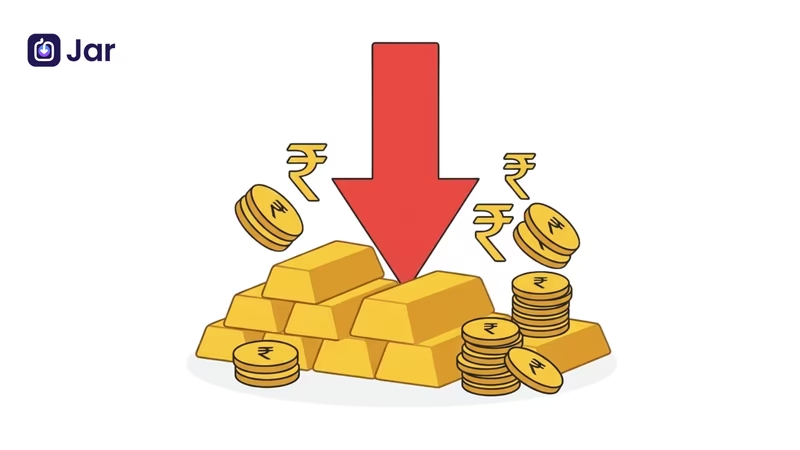


Gold prices declined. Gold prices started the month on a positive note but then sold off sharply at the end of August. Gold saw a drop of 3% in a day, its biggest one-day fall in weeks, after touching around $4,600+ per ounce globally and ₹1.62-1.63 lakh per 10g on India’s MCX. MCX gold futures for October delivery settled at ₹1.52-1.54 lakh/10g, down sharply from ₹1.63 lakh/10g for Indian investors.
This painful correction teaches long-term gold investors a valuable lesson: short-term volatility is a fact of life in precious metals markets.
What Triggered the Drop in Gold Prices?
Federal Reserve Hawkishness and Rate Expectations
The price decline was driven primarily by a shift in Federal Reserve sentiment toward a more hawkish path. Fed Chair Kevin Warsh said at the Jackson Hole symposium that underlying inflation has not “meaningfully improved” and price stability is the Fed’s top priority, leading markets to expect possible rate hikes down the road. When the Fed says it’s going to raise rates, the cost of holding non-interest-bearing assets such as gold goes up. Also, a stronger US dollar, which usually comes with higher rate expectations, makes gold more expensive for international buyers, reducing demand and pushing prices down.
Profit Taking After Strong Rally
Gold had been on a strong rally at the beginning of the month with many investors building long positions. Gold dropped below key support levels as sophisticated investors began to take profits following hawkish comments from the Fed, sparking technical selling. The result was a self-reinforcing feedback loop: falling prices prompted more selling, which made prices fall faster. This created a feedback loop. Prices falling led to more selling, which led to prices falling faster.
Oil Prices, Inflation Concerns
This period also saw a rise in geopolitical tensions, which pushed crude oil prices above $90-91 a barrel. Higher oil is generally supportive of gold as an inflation hedge, but the dominant effect was: higher oil --> higher inflation fears --> stronger case for Fed rate hikes --> higher yields and stronger dollar --> gold falls. While higher oil normally supports gold as an inflation hedge, the dominant effect was: higher oil → higher inflation fears → stronger case for Fed rate hikes → higher yields and stronger dollar → gold falls.
Indian Market Context
In India, retail 24K gold prices dropped from about ₹1.62 lakh/10g earlier in the week to around ₹1.59 lakh/10g as the decline progressed, with continued pressure in early September. Indian gold prices closely track global spot prices while also being influenced by the USD/INR exchange rate, import duties, and local demand patterns.
Why This Matters: The Big Gold Story
The recent dip made all the headlines, but it’s worth putting it into perspective with gold’s longer-term performance. Gold had a strong rally in 2024 and 2025, setting new highs in the international and domestic markets. In 2024, gold alone soared nearly 25.5%, its best annual performance in 14 years. Gold’s rally continued through May 2025 and was up 25% YTD before hitting a new high of $3,500/oz (~₹99,350) in April.
Some structural factors are underpinning this multi-year bull market: Demand from emerging market central banks, especially in China, Russia, and India, has purchased a lot of gold to diversify away from dependence on the U.S. dollar. This steady institutional demand provides a floor.
Geopolitical Uncertainty
The Russia-Ukraine conflict, the Middle East tensions, and the South China Sea disputes remain unresolved, which continues to drive investors to gold as a traditional safe haven during times of global uncertainty.
Inflation Hedge
In an environment of elevated inflation across major economies, gold remains one of the most effective wealth preservation tools. Gold offers real purchasing power protection, while fixed income assets are negative in real terms.
Currency Volatility and Fed Policy
Whether the Fed is cutting rates (reducing the opportunity cost of gold) or hiking rates (strengthening the dollar), gold's role in portfolio construction remains vital. Short-term price swings often reflect confusion about policy direction rather than fundamental deterioration in gold's value proposition.
Digital Gold: A Modern Solution for Gold Investors
This is where digital gold platforms like Jar fit into the evolving gold investment landscape.
What is Digital Gold?
Digital gold gives investors the opportunity to own fractions of physical gold without the hassle of storage, insurance, or purity issues. So, you don’t have to buy physical bars or coins. You can invest small amounts (even ₹10) via an app and own gold that is stored physically in secure vaults.
Why Digital Gold Matters Now
Accessibility: Traditionally, investing in gold required a huge amount of capital and knowledge of hallmarking standards. Digital gold offers access so that millennials and tech-savvy investors can establish positions in gold along with equity and debt positions.
Volatility Management: In a steep sell-off like the current one, digital gold platforms offer a psychological advantage – it is easy to top up with dips without the hassle of going to jewelers or dealers. The recent correction is not a crisis; it’s a buying opportunity.
Portfolio Diversification: When equity markets are in turmoil and geopolitical tensions are high, digital gold is a non-correlated asset class. The current decline, despite its sharpness, still represents historically reasonable valuations for long-term wealth preservation.
Lower Friction: No making trips to dealers, no concerns about purity certificates, no storage worries. You invest through your phone and can liquidate instantly.
What Should Investors Do Now?
The current price dip presents a critical juncture for gold investors. Rather than panic selling, this moment calls for strategic thinking:
For Long-Term Investors:
This correction is an ideal buying opportunity. Gold's fundamental drivers—geopolitical uncertainty, central bank demand, and real yield concerns—remain intact. The sharp decline has temporarily created more attractive entry points for those building positions for the next 3–5 years.
For Dollar-Cost Averaging Advocates:
The beauty of volatility is that it rewards disciplined, recurring investment strategies. Set up systematic gold purchases (daily, weekly, or monthly) to benefit from averaging into positions. When prices are lower, your regular contributions buy more gold—a powerful advantage that compounds over time.
For Portfolio Rebalancers:
If your asset allocation has drifted due to gold's prior rally, use this dip to rebalance back to your target gold allocation. This disciplined approach forces you to systematically "buy low" and maintain your desired risk profile.
For New Investors:
If you've been waiting for a better entry point, the timing is now. Gold's accessibility has improved significantly, whether through digital gold SIPs, Gold ETFs, Gold SIPs, or traditional dealers, making it easier to begin your gold investment journey without significant capital commitment.
Watch the Key Drivers:
Going forward, gold's direction will depend heavily on US economic data (jobs reports and inflation metrics), Fed commentary and policy meetings, and geopolitical developments. Any hint that the Fed may pause, hike less, or hike more will move yields, the dollar, and ultimately gold prices. Keep a close eye on these factors to inform your timing and positioning.
Key Principle: View volatility as your friend, not your enemy. The investors who thrive in gold markets are those who maintain conviction in gold's long-term value during short-term price swings.
Key Terms You Should Know
Here are the main technical terms used above, explained simply:
- Federal Reserve (Fed): The central bank of the United States. It decides US interest rates.
- Interest rate hike: When the Fed increases its policy rate, making borrowing more expensive and savings/bonds more attractive.
- Hawkish vs dovish:
- Hawkish: Focused on controlling inflation, okay with higher rates.
- Dovish: Focused on growth/employment, prefers lower rates.
- Treasury yields: The interest rate you earn by lending money to the US government via bonds. When these rise, gold often falls.
- US dollar index (DXY): A measure of the dollar’s strength against a basket of currencies. A stronger dollar usually pressures gold.
- Non‑yielding asset: An asset like gold that does not pay interest or dividends.
- Profit‑booking: Selling an asset after its price has risen to lock in gains.
- MCX: Multi Commodity Exchange of India, where gold and other commodities are traded as futures.
Disclaimer: This report contains opinions, which are not to be construed as investment indications. The opinions mentioned above are based on information which is believed to be accurate, and no assurance can be given for the accuracy of the information. Past results are no indication of future performance. Information provided in this report is intended solely for informative purposes and is obtained from sources believed to be reliable. The reports are only for information purposes and are not to be construed as investment advice.