


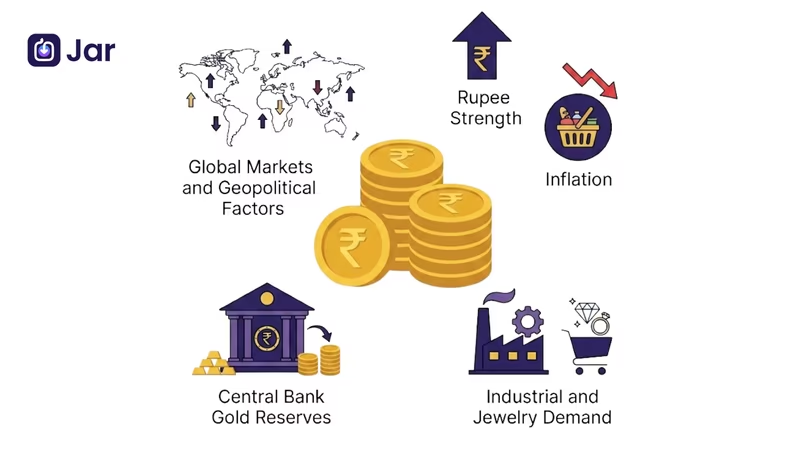


Gold in India is almost mythical. It is handed down through families from generation to generation; brides adorn it at weddings, and farmers in rural Maharashtra buy it as soon as a good harvest comes in.
But beneath all that cultural heft is a commodity whose price fluctuates day-to-day, sometimes wildly, based on factors from the US Federal Reserve to the monsoon season in Bihar.
Whether you are buying gold or just buying jewellery, knowing what drives the price can save you real money. All the major factors that affect gold prices in India and how you can use this knowledge to buy smarter.
Gold Is a Global Commodity With Very Local Drivers
Gold is priced in US dollars on international markets. But by the time it reaches a jeweller's display case in Chennai or a digital gold app on your phone, a whole chain of domestic forces — customs duties, currency exchange rates, festival demand, and RBI policy — has already reshaped the final number.
That's what makes gold prices in India uniquely complex. You're dealing with global economics and deeply local traditions at the same time. Let's go through each driver.
US Dollar Strength and the USD Gold Relationship
The single biggest external force on gold prices is the strength of the US dollar. Gold is globally traded in USD, so the two tend to move in opposite directions. When the dollar gets stronger than other currencies, it makes gold more expensive for buyers outside the US — which cuts demand and drags prices lower. When the dollar weakens, gold becomes relatively cheaper globally, demand picks up, and prices climb.
Why This Matters Specifically for India
India imports almost all of its gold. The price you pay is essentially the international USD price converted into rupees. So if the dollar strengthens against the rupee — even if the global gold price in USD stays flat — the price of gold in India goes up. This is a double exposure situation: you're affected by both the USD-gold relationship and the USDINR exchange rate simultaneously.
Gold purchasers in India should keep an eye on both the DXY (US Dollar Index) and the USD/INR exchange rate. A weak dollar combined with a strong rupee is generally the most favourable environment for buying gold at a lower price domestically.
Global Inflation and Interest Rates
Inflation and interest rates are probably the most discussed drivers of gold prices globally — and for good reason. The relationship is consistent and logical.
Gold as an Inflation Hedge
When inflation rises, the purchasing power of paper currency falls. People look for assets that hold their value — and gold has done exactly that for thousands of years. As inflation climbs, demand for gold goes up, and so does its price. This is why gold often performs well during periods of economic stress.
The Interest Rate Connection
Interest rates and gold are inversely related. When central banks raise interest rates, bonds and savings accounts begin to offer better returns. Gold, which pays no interest or dividend, becomes relatively less attractive. Supply increases as investors sell gold to move into interest bearing assets, pushing prices down.
The reverse is equally true: low interest rates reduce the "opportunity cost" of holding gold. With little to gain from keeping money in a fixed deposit, investors park it in gold instead, driving demand and prices higher.
The US Federal Reserve's rate decisions are particularly important here because they influence global capital flows. Even the RBI's repo rate decisions affect domestic gold demand in a similar way.
Central Bank Gold Buying and the RBI's Role
Central banks worldwide hold gold as part of their foreign exchange reserves, and their buying or selling decisions can meaningfully move the market.
The Reserve Bank of India (RBI) is an active participant in the gold market. When the RBI increases its gold reserves — which it has done steadily in recent years — it adds to institutional demand, which supports higher prices. Conversely, when central banks sell gold, they add supply to the market and can push prices down.
This isn't just an Indian phenomenon. When multiple central banks globally increase their gold purchases simultaneously — as has happened during periods of geopolitical uncertainty — the combined effect on prices can be substantial. India's gold market is sensitive to both RBI policy and the broader behaviour of G20 central banks.
Indian Festival and Wedding Season Demand
No factor is more uniquely Indian in its influence on domestic gold prices than the festival and wedding calendar. India is one of the world's largest consumers of gold, and demand is heavily concentrated in specific months of the year.
The Festival Effect
Gold demand in India surges during religious festivals — Dhanteras, Diwali, Akshaya Tritiya, and Ganesh Chaturthi are the peak buying occasions. Purchasing gold on Akshaya Tritiya is considered especially auspicious, and the buying that happens on this single day is enough to visibly move the domestic market.
During these periods, jewellers stock up in advance, retail demand spikes, and prices often edge higher. If you're planning a significant gold purchase, buying a few weeks before the festival season rather than during it can make a noticeable difference.
The Wedding Season Effect
India has roughly 10 million weddings a year. The wedding season typically runs from October to December and again from April to June. Gold jewellery is central to Indian weddings — in many communities, it's the primary form of gifting and a marker of family status. This creates a predictable annual surge in demand that drives prices higher during peak wedding months.
The World Gold Council estimated that Indian households have accumulated around 25,000 tonnes of gold — making India the world's largest private holder of this metal. Much of that accumulated wealth can be traced directly to generations of wedding and festival purchases.
Rural India and the Monsoon Factor
Rural demand plays an outsized role in India's overall gold consumption, accounting for an estimated 800–850 tonnes annually. Good monsoon seasons lead to strong agricultural harvests, which put more disposable income in the hands of rural households. A significant portion of that income historically flows into gold. A poor monsoon, by contrast, dampens rural purchasing power and can soften gold demand even during festival periods.
Government Policy, Customs Duty, and Budget Announcements
Since India produces less than 1% of its gold domestically, virtually everything consumed here is imported. That makes customs duty a direct lever on the price Indian consumers pay.
How Import Duty Shapes Domestic Gold Prices
When the government raises import duty on gold, the landed cost of gold rises, and that increase is passed straight to the consumer. When duty falls, prices ease. It's one of the most direct policy tools the government has to influence gold affordability.
Union Budget 2026 Changes
The Union Budget 2025 brought meaningful changes to gold and jewellery pricing. The government reduced customs duty on articles of jewellery (HSN codes 7113 and 7114) from 25% to 20%, which lowered the cost of imported jewellery. Import duty on platinum findings was cut sharply from 25% to 5%, though a 1.4% Agriculture Infrastructure and Development Cess was imposed on platinum findings.
The government also introduced a separate HSN code for gold and platinum alloys — a move aimed at reducing classification malpractice and bringing greater transparency to the market.
For consumers, these duty reductions are genuinely good news. Lower import costs reduce production costs for manufacturers, which should translate into slightly more competitive pricing for finished jewellery. For small jewellery businesses that operate on thin margins, reduced input costs can mean the difference between expansion and contraction.
Geopolitical Events and Safe-Haven Demand
Gold has been a safe-haven asset for centuries, and that behaviour is still very much alive. When geopolitical uncertainty spikes — wars, sanctions, trade conflicts, or political instability — purchasers globally move capital into gold as a store of value.
The COVID19 pandemic in 2020 was a textbook example. As global economic uncertainty surged, gold prices climbed sharply, touching all-time highs as purchasers scrambled for safety. Similarly, geopolitical events in Eastern Europe and the Middle East in subsequent years triggered fresh rounds of safe-haven buying.
For India specifically, any global event that drives up international gold prices immediately feeds into domestic prices — given the import dependency. This is why Indian gold prices often move in sympathy with global events that seem geographically distant.
The Inverse Relationship With Equity Markets
There's also a consistent inverse relationship between gold prices and the Sensex. During a bull market in equities, purchasers chase higher returns in stocks and reduce their gold allocation, softening demand. When stock markets fall and a bear phase sets in, money rotates back into gold. This makes gold a useful portfolio balancer — it tends to hold value or rise when the rest of your portfolio is under pressure.
Crude Oil Prices
Crude oil and gold share an indirect but meaningful relationship. When oil prices rise sharply, inflation tends to follow — energy costs ripple through supply chains, raising prices across the economy. Investors anticipating higher inflation then turn to gold as a hedge, which pushes demand and prices higher.
There's also a currency dimension: both gold and crude oil are priced in US dollars on global markets. A weakening dollar tends to push up the prices of both commodities simultaneously, which is why periods of dollar weakness often see gold and oil rising together.
It's worth being clear that this relationship isn't perfectly linear — other factors can override it — but historically, sustained periods of high crude oil prices have generally been supportive of gold prices.
How to Use This Knowledge to Time Your Gold Purchases
Understanding these factors doesn't give you a crystal ball, but it does give you a framework for making smarter decisions. Here's how to apply it practically:
Watch the dollar. If the US dollar is weakening and the Indian rupee is holding steady or strengthening, international gold prices tend to rise, but the domestic impact is buffered. A weak dollar with a stable rupee is often a window of relative affordability.
Buy before festival season, not during it. Prices typically creep up in the weeks leading into Dhanteras, Diwali, and Akshaya Tritiya. If you're planning to buy anyway, purchasing a month or two before peak festival demand is generally cheaper than buying at peak season.
Monitor the RBI and US Fed rate decisions. Rate hikes put downward pressure on gold; rate cuts or pauses tend to support higher prices. If a rate cut cycle is beginning, gold prices are more likely to rise in the coming months.
Track import duty announcements during the Union Budget. The government's annual budget can directly change the cost of imported gold overnight. Duty reductions like the one in Budget 2025 can create short windows of relatively lower prices.
Use gold as a portfolio hedge, not a trading instrument. Timing gold purchases perfectly is difficult even for professional fund managers. A better approach for most investors is consistent, regular accumulation — using tools like digital gold platforms that let you invest small amounts automatically — so you average out your entry price over time.
Pay attention to geopolitical signals. If global tensions are escalating, gold prices are likely to remain elevated or climb further. Waiting for geopolitical calm before buying may mean waiting a long time — and prices may have moved significantly by then.
Gold isn't just a metal; it's a reflection of currency health, geopolitical confidence, agricultural prosperity, and consumer sentiment all at once. The more clearly you understand these forces, the better positioned you are to make gold work for your financial goals rather than simply reacting to price movements you don't understand.
Whether you're buying physical jewellery for a wedding, accumulating digital gold through a savings app, or building a long-term investment position, the fundamentals covered here give you a genuine edge in knowing when and why gold prices move and how to act on that knowledge.
FAQs
What is the single biggest factor affecting gold prices in India?
The gold price is influenced by a number of factors, including the US dollar exchange rate, global inflation, domestic demand from festivals and weddings, and the government's import duty policy. But on a day-to-day basis, the USDINR exchange rate and global inflation together tend to have the most consistent influence on Indian gold prices.
Why does gold price go up when inflation rises?
When inflation rises, the purchasing power of money falls. Buyers purchase gold since it does not lose value during inflation like cash does. More demand makes the price of gold go up. Gold has historically been one of the most effective long-term hedges against inflation in all markets worldwide.
How does the US dollar affect gold prices in India?
Gold is globally priced in US dollars. When the dollar strengthens, gold becomes more expensive for nonUS buyers, reducing demand and pulling prices down. When the dollar weakens, gold becomes relatively cheaper globally, demand increases, and prices rise. For India, this is compounded by the USD/INR exchange rate — a weaker rupee makes imported gold more expensive regardless of what happens globally.
When is the best time of year to buy gold in India?
From a demand perspective, prices tend to be calmer in the months before the major festival seasons — roughly AugustSeptember before the OctoberDecember peak. Post-festival periods (JanuaryFebruary) can also see slightly softer prices. That said, consistently buying small amounts through the year — using SIPs or digital gold platforms — tends to produce better average prices than trying to time a single large purchase.
Did the Union Budget 2025 make gold cheaper in India?
The Budget 2025 reduced customs duty on imported jewellery from 25% to 20%, which should modestly reduce the cost of finished gold jewellery for consumers. Import duty on platinum findings was cut significantly from 25% to 5%. These reductions lower production costs for manufacturers, and part of that saving should pass through to retail prices over time.
What happens to gold prices when the stock market falls?
Gold and equity markets have a tendency to move in opposite directions. When Sensex or Nifty falls, buyers tend to shift money to gold as a safer asset, and demand increases and gold prices go higher. One of the main reasons financial advisors suggest holding some gold in a diversified portfolio is this inverse correlation.