


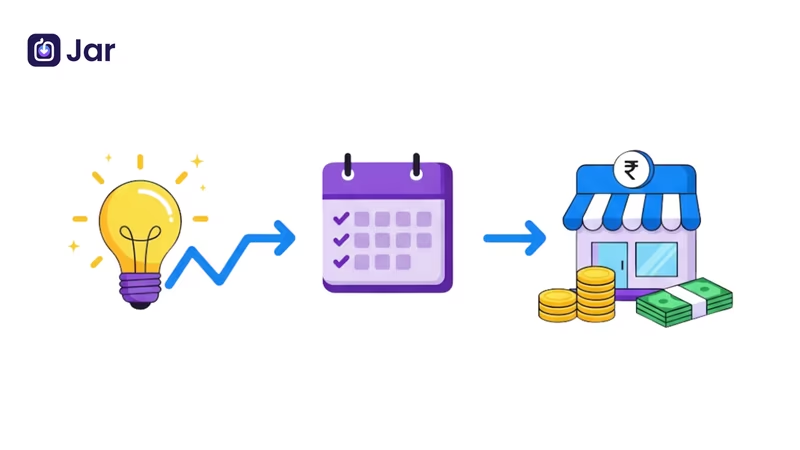


Starting a business is one of the most powerful ways to create financial independence, professional freedom, and long-term wealth.
Whether you want to build a full-time company or a profitable side hustle, the process of starting a business follows a clear, structured path.
You might have thought many times about “how do I start a business?” This detailed guide will help you understand the process of how to start a business and will walk you through the complete process, including tips you need to know before starting a business.
Choose a Business Idea & Do Market Research
Every business starts with an idea. But ideas alone are not enough. They should be backed by validation that people are willing to pay for what you offer.
Many entrepreneurs jump into business without proper validation and end up with products or services no one wants. This can be avoided by doing solid market research.
You can start this by asking:
- What problem am I solving?
- Who will buy this product or service?
- Why would customers choose your business over your competitors?
Conduct market research by:
- Studying competitors
- Checking Google search trends
- Analyzing customer reviews
- Surveying potential users
The goal is to ensure there is real demand before you invest heavily.
Create a Detailed Business Plan
A business plan defines a company’s roadmap for success and also acts as a guide for investors.
It explains what you are building, how the business will earn money, and how it will grow.
A business plan should include:
- Business description
- Target market
- Products or services
- Pricing strategy
- Marketing Strategy
- Startup and operating costs
- Revenue projections
To start with, you can also have a simple one-pager plan that will give you direction and keep you focused.
Note: Your business will evolve, and so will your business plan. Write it now, but plan to revisit and update it every quarter. Markets change, costs shift, and customer preferences evolve.
Checkout the world's best business opportunities to start.
Choose Your Business Structure
Your business structure defines how you file taxes, your personal liability, how much paperwork you'll handle, and your ability to scale.
Common options include:
- Sole Proprietorship: Simple and low-cost, best for freelancers and small businesses
- Partnership: When two or more people run a business together
- Private Limited Company: Best for startups planning to raise funding and scale
- LLP (Limited Liability Partnership): Combines flexibility with legal protection
- One Person Company (OPC): This is for a single owner wanting limited liability.
Choose a structure based on growth plans, funding needs, and legal safety.
Choose the Business Name and Branding
Your business name is your first impression. It should be:
- Easy to remember
- Relevant to your industry
- Available as a domain name and on social media
Branding also includes your logo, colors, tone of voice, and positioning.
A strong branding will help build trust and make marketing easier.
Register Your Business
A business registration will make your business venture legal and open doors for formal credit, government schemes, and contracts.
Registering your business typically includes:
- Company or LLP registration (if applicable)
- PAN and TAN
- MSME (Udyam) registration
- GST registration (if required)
The registration process varies slightly by structure, but here's the general flow:
For Sole Proprietorship or Small Partnership:
You'll primarily register under your state's Shops and Establishments Act. This registration is mandatory for any business operated from a fixed location (a shop, office, or workshop).
For Companies and LLPs:
The process of registration happens at the national level through the Ministry of Corporate Affairs (MCA) portal.
The Registration Steps (for companies/LLPs):
First, obtain a Digital Signature Certificate (DSC) and Director Identification Number (DIN) for all proposed directors.
You can get these online from authorized certifying authorities. DSC is required to sign documents electronically, and DIN is your unique identifier as a director.
Second, reserve your company name through the MCA portal. Submit two names in order of preference.
The name must comply with naming conventions and not infringe on existing trademarks. You'll get approval within a day or two.
Third, prepare your incorporation documents: Memorandum of Association (MoA) outlining your company's objectives and scope, and Articles of Association (AoA) detailing internal management policies. For LLPs, you'll need an LLP agreement.
Fourth, file the SPICe+ form along with supporting documents through the MCA portal. This is a single form that consolidates the incorporation process.
Include your company details, authorized capital, registered office address, and director/shareholder information.
Fifth, wait for verification and approval. The Registrar of Companies will examine your documents, typically taking 15-30 days. They might ask for clarification.
Finally, once approved, you'll receive the Certificate of Incorporation, which is your company's birth certificate. You'll also get a DIN (if you're a director) and a CAIN (Company Identification Number).
Timeline and costs:
The entire process takes 15-30 days, depending on document completeness and registrar workload.
Registration fees typically range from ₹10,000 to ₹25,00,0, depending on your authorized capital. Some states charge stamp duty (0.1%-0.3% of authorized capital).
Obtain Licenses and Compliances
Now that your business is registered, you need specific licenses depending on your sector.
Depending on your industry, you may need any one of the following:
- GST registration
- Sector-specific license
- Shop and Establishment license
- FSSAI for food businesses
- Professional tax registration
- Local or sector-specific permits
- Import Export Code (IEC) if you're importing or exporting
- Pollution clearances and factory licenses, if you’re manufacturing
Legal compliance protects your business from penalties and shutdowns.
Open a Business Bank Account
Keeping business and personal finances separate is non-negotiable. It protects you legally, makes accounting easier, and is essential for tax compliance and loans.
- Tracking income and expenses
- Paying taxes
- Applying for loans
- Building financial credibility
Never mix personal and business finances.
What you need to open a business bank account-
- Business registration documents (certificate of incorporation or registration proof)
- PAN
- Identity proof
- Address proof
If you're a sole proprietor, you need to show your business registration proof and personal ID.
Get Business Insurance
Business insurance will protect you against:
- Legal claims
- Property damage
- Employee injuries
- Professional mistakes
Even small businesses should have at least basic liability and asset insurance.
Develop Your Brand and Online Presence
In today’s digital world, customers look you up online before buying.
Develop Your Brand and Online Presence
In 2026, ignoring digital presence is a recipe for limited growth. Your brand is how customers perceive you.
Customers look for your online presence before buying, and this is a non-negotiable.
While building a digital presence, make sure you have
- A professional website
- Social media profiles
- Google Business listing if you are a local business
- Online reviews and testimonials
This builds trust and helps customers find you easily.
Get Funding
You will need capital to start and grow your business.
Common options include:
- Personal savings
- Family and friends
- Bank loans
- Government startup schemes
- Angel investors and venture capital
Always raise money with a clear plan for how it will generate returns.
Some of the government-backed schemes are
Pradhan Mantri Mudra Yojana (PMMY)
The most accessible scheme. Offers loans up to ₹10 lakhs with reasonable interest rates. Through PMMY, you can get three tiers: Shishu (up to ₹50,000), Kishor (₹50,000 to ₹5 lakhs), and Tarun (₹5 to ₹10 lakhs). SBI charges 0% fees for Shishu and Kishor loans.
PM CGTMSE (Credit Guarantee Scheme)
Offers up to ₹3 lakhs with a 30% subsidy for small industries. Great for manufacturing businesses.
Startup India Scheme
For recognized startups, loan amounts up to ₹50 crores are possible. You also get angel tax exemptions on investments up to ₹25 crores.
DPIIT Recognition
Get your startup recognized by the Department for Promotion of Industry and Internal Trade (DPIIT) for angel tax exemptions, reduced registration fees, and access to grants.
Self-Reliance Fund
Launched specifically to support small businesses during economic challenges. Amount and eligibility vary.
Non-Government Options
Angel investors, venture capital funds (though these expect significant equity), bank loans based on your personal creditworthiness, and crowdfunding through platforms.
Launch and Market Your Business
With everything in place, it's time to go live. But registration and licenses don't bring customers; marketing does. You need to introduce your business to the world.
Focus on:
- Digital marketing (SEO, ads, social media)
- Referral programs
- Partnerships
- Promotions and offers
Listen to customer feedback and keep improving your product or service.
Looking for an easy way to start a business? You can look for some of the best franchise businesses in India.
Common Mistakes to Avoid
Learning from others' mistakes can save you time, money, and frustration.
Wrong business structure: Choose based on your scale plans and liability needs, not just simplicity. A wrong choice later becomes expensive to fix.
Ignoring regulatory compliance: GST, TDS, EPF/ESI, labor laws—non-compliance leads to penalties, business shutdown, and legal trouble. Allocate budget for compliance from day one.
Poor financial planning: Underestimating costs, overestimating revenue, and inadequate working capital kill most startups. You should be realistic and conservative with projections.
Start saving for your business finance today on the Jar app with just ₹50!
Mixing personal and business finances: This creates accounting nightmares and potential legal issues. Have a separate bank account from day one.
No market research: Don't assume people want your product. Validate first. Talk to customers before launching.
Overexpansion too soon: Entrepreneurs get excited after early success and expand before stabilizing the core business. Instead, they should build a solid foundation first.
Ignoring customer feedback. Listen to your customers. Their feedback reveals what's working and what's not. Adapt quickly.
Poor record-keeping. Without proper documentation, you can't file taxes accurately, access credit, or scale confidently.
Learn about the top 10 most successful businesses to start in India.
FAQs
How much capital do I need to start a business?
Demand for capital depends on your business type. Service-based businesses might need as little as ₹50,000, while manufacturing or retail might need ₹5-25 lakhs. Essentially, a business should have 3-6 months of operating expenses plus initial setup costs.
How long does a business registration take?
Sole proprietorship registration can take 5-10 days. Companies and LLPs take 15-30 days. Fast-track services can speed this up, but basic timelines are predictable.
Do I need a business license to start?
For most businesses, yes. Sole proprietors need Shops and Establishments registration. Companies and LLPs need MCA registration. GST registration is mandatory if turnover exceeds the threshold.
Can I change my business structure later?
Yes, but it's complex and costly. Choose carefully from the start, but know you can upgrade as you grow.
What's the most common reason businesses fail?
Most of the businesses fail because of poor financial management and planning. Many businesses launch even before validating the demand, and then run out of cash before finding customers. By proper research and planning, this can be avoided.