



Gold prices keep making headlines, and for most people, it raises a simple question: why does the gold price trend keep changing? One month it’s “all-time high,” the next it’s “cooling off.”
This blog breaks down the real forces behind the gold price trend. We’ll look at how inflation, interest rates, global uncertainty, and policy decisions shape gold prices, and what patterns from the past still matter today.
If you’re tracking the gold price trend to decide whether gold fits into your savings plan, this is where clarity starts.
4 main reasons why gold prices move
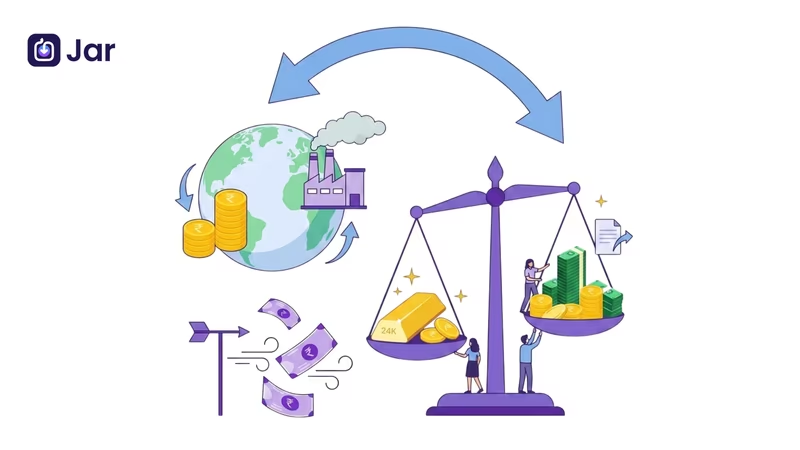
Gold price trend moves for a few repeatable macro forces:
- Inflation: When everyday money loses purchasing power, gold tends to look sturdier. That’s why inflation spikes often push the gold price trend up.
- Interest rates: Higher rates make cash and bonds more attractive, which can cool the gold market price trend. Lower rates do the opposite.
- US dollar strength: Gold is priced in dollars. A stronger dollar pressures the gold price trend downward; a weaker dollar gives it room to rise.
- Global uncertainty: Wars, recessions, banking stress - gold’s “safe haven” reputation kicks in fast.
| Factor | What happens | Effect on the gold price trend |
| Inflation rises | Currency buys less | ⬆️ Often up |
| Interest rates rise | Cash pays more | ⬇️ Often down |
| Dollar weakens | Gold cheaper globally | ⬆️ Often up |
| Crisis headlines | Risk-off behavior | ⬆️ Often up |
How US futures trading influences the gold price trend
A big part of today’s gold price trend is set in the US futures market on COMEX (run by CME Group).
Traders here buy and sell gold contracts that act as a real-time price signal for the world. Even though most deals don’t involve physical delivery, these trades strongly influence how gold is priced globally, especially as more activity now occurs during Asian market hours.
Myths people spread about what moves gold prices
What doesn’t move gold:
- Festival or wedding-season demand
- Daily headlines and social media predictions
- Short-term speculation
The Indian gold culture may cause brief bumps, but they don’t define the gold price trend.
What actually moves prices:
- Supply: Mining output changes marginally each year, causing long-term pressure
- Demand: Central bank gold reserves, large investors, and ETFs influence prices more than short-term retail buying
- Policy and currency: Interest rates and the strength of the US dollar are key factors
Gold price trend last 5-year timeline
Below is how the gold price trend has moved in India, using 24-karat gold prices (₹/10g).
| Year | Gold price (₹/10g) | What this shows about the gold price trend |
| 2020 | 50,151 | Pandemic shock pushed gold into focus |
| 2021 | 48,099 | The recovery phase cooled prices slightly |
| 2022 | 55,017 | Inflation fears lifted the gold price trend again |
| 2023 | 63,203 | Banking stress + uncertainty strengthened demand |
| 2024 | 78,245 | Clear breakout as confidence in currencies weakened |
| 2025 | 1,36,570 | New highs - gold price trend fully reset |
What this timeline makes obvious
- The gold price trend didn’t just rise - it re-priced entirely after 2023
- Pullbacks became smaller, while new highs kept forming
- Gold investment trends now focus on long-term allocation, not short-term timing
When will the gold price drop?
Gold prices drop usually when three things line up, and they rarely do for long.
- Interest rates stay high for longer: If cash and bonds keep paying well, some money moves out of gold, easing the gold price trend.
- The US dollar strengthens: A stronger dollar makes gold pricier globally, which can cool demand and flatten the gold market price trend.
- Risk fades: Fewer recession fears, calmer geopolitics, stable banks, gold loses its urgency.
Here’s the catch: gold price trends have changed a lot since 1950, but the short-term changes are temporary. That’s why pullbacks often look like pauses, not crashes. Over time, the gold price trend resets at higher levels.
What the gold price trend signals about the economy
The gold prices rise when confidence in currencies weakens or economic risks increase. High prices reflect inflation worries, rate expectations, and uncertainty, not hype.
Is gold price volatility a risk for long-term investors?
Short-term ups and downs are normal. The gold price trend reacts to changing views on interest rates and stability. That volatility doesn’t cancel gold’s role; it’s part of how the market processes risk.
Final thoughts: Use gold price trends when planning your savings
You don’t need to predict the gold price trend to benefit from gold. Its role is stability, not quick gains. High prices usually signal economic stress; dips reflect short-term shifts in rates or policy.
Neither is a reason to panic.
For most savers, consistency matters more than timing. Investing small amounts regularly smooths out volatility and keeps emotions in check.
The Jar App helps with exactly that. It lets you invest in digital gold in small, regular amounts - no storage issues, no timing stress.
Build long-term protection for your savings even during gold price instability with the Jar App
FAQs about the gold price trend
Is gold expected to go up or down?
Up. The gold price trend is expected to rise in 2026, largely due to global political distress, central bank buying, and weakening confidence in fiat currencies.
Will gold rates crash in India?
No, a crash is extremely unlikely. Corrections can happen, but the structural gold price trend in India is supported by global demand, currency pressure, and central bank accumulation.
What did J.P. Morgan say about gold?
J.P. Morgan projects gold reaching $5,000-$6,000/oz by 2026-2028, driven by central bank demand, ETF inflows, investor diversification, and potential Fed rate cuts.