


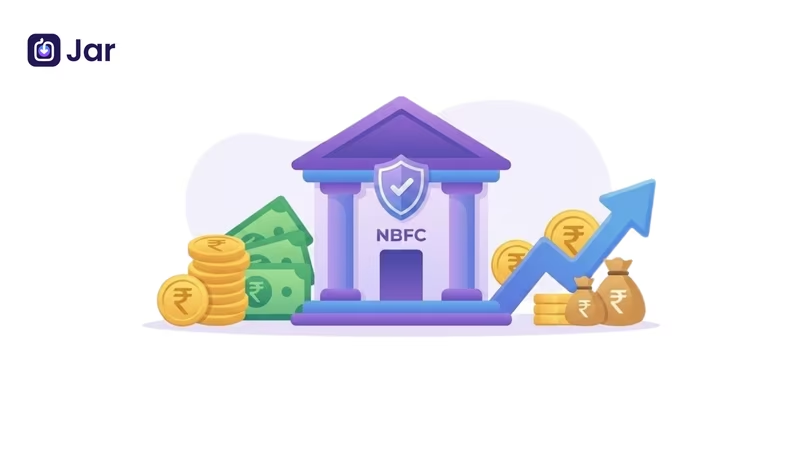


If you've ever looked for a personal loan or bought a gadget on EMI, you've probably used an NBFC without even knowing it.
Banks are the big players in the financial world, but NBFCs are the nimble ones that keep the economy going by reaching people that banks often miss.
Let's take a closer look at what this term means, how it works, and why it matters to your money.
What is the NBFC full form?
A non-banking financial company is what NBFC stands for.
An NBFC is a type of financial institution that provides banking services like loans, credit, and investments, but it doesn't have a full banking license.
In the financial system, they are like the "bridge." They fill the gap between traditional banks and people who need quick, flexible help with money.
What Does NBFC Stand for in Banking?
When we talk about the full form of NBFC in banking, we mean how these businesses work with banks. They help banks, but they don't take their place.
Banks take care of savings and big loans to businesses, but NBFCs often take care of the "last mile" of financing. They give small loans to people, pay for trucks and equipment, or give credit to small businesses.
What does an NBFC do?
NBFCs can do a lot of different things. They register under the Companies Act (1956 or 2013) and mostly do the following things for business:
- Loans and advances: personal loans, loans for gold, and loans for housing. Asset financing is money for machinery, cars, and other equipment.
- Investments: buying stocks, bonds, shares, and other securities.
- Leasing and hire-purchase: models for renting or buying vehicles or other large items.
How NBFCs Help People Who Need Money
- Speed: NBFCs are known for processing things quickly. An NBFC usually gives out emergency loans faster than a regular bank does.
- Flexibility: They usually have less strict rules about who can get them, which makes them a great option for people with bad credit or no credit history.
- Digital Lending: Most of the "instant loan" apps you see today are built on NBFCs. They work with fintech companies to make online lending as easy as possible.
The Big Question: What Makes an NBFC Different from a Bank?
This is the most common thing that people get wrong. So what's the difference since they both lend money? The main difference is in demand deposits, which are savings and checking accounts.
| Feature | Banks | NBFCs |
| Deposits | Can accept Demand Deposits (Savings/Current accounts) withdrawable anytime. | Cannot accept Demand Deposits. (Some can accept Term Deposits with specific permission). |
| Payment System | Part of the payment settlement system (can issue cheques). | Not part of the settlement system (cannot issue self-drawn cheques). |
| Deposit Insurance | Deposits are insured by DICGC (up to ₹5 Lakh). | Deposits are not insured. |
| Regulation | Strictly regulated under the Banking Regulation Act. | Regulated by RBI under the Companies Act & RBI Act. |
Regulation: Is the RBI aware of every NBFC?
In general, yes. For an NBFC to be able to do business legally, it must be registered with the Reserve Bank of India (RBI).
But there are some cases where "dual regulation" is not allowed. An NBFC doesn't need an RBI license if it is already regulated by another big authority. For instance:
- Stock Broking Companies (Regulated by SEBI)
- Insurance Companies (Regulated by IRDAI)
- Housing Finance Companies (regulated by the National Housing Bank, though regulatory powers have shifted recently to the RBI; they have distinct categories).
Note: The RBI does not guarantee your money just because an NBFC is registered. Always check the company's finances before putting money into their fixed deposits (if they are allowed to accept them).
NBFCs have evolved from being just shadow banks to becoming the backbone of credit for millions of individuals and small businesses.
Whether it is funding your dream phone through zero-cost EMI or providing capital for a small startup, non-banking financial companies ensure that money keeps flowing where traditional banks might not reach.
However, as a borrower or investor, due diligence is key. Always verify the registration of the NBFC with the RBI and read the terms carefully. In a rapidly digitizing world, NBFCs are not just an alternative; they are an essential part of a healthy financial ecosystem
Frequently Asked Questions
1. Which NBFC is the best in India?
Bajaj Finance Limited is often thought of as the best NBFC in India based on its market capitalization and how popular it is with customers.
But when it comes to the size of their assets, government-backed NBFCs like Power Finance Corporation (PFC) and REC Ltd are huge.
2. Is an NBFC a business that is not owned by the government?
Most of the NBFCs you deal with, such as Muthoot Finance or Bajaj Finserv, are private companies.
But some NBFCs are owned by the government, like the Power Finance Corporation (PFC). So, they can be either, but most people think of them as "private."
3. Is NBFC a part of RBI?
Yes. The Reserve Bank of India (RBI) is the main body that regulates NBFCs. They make sure that these businesses follow the rules when they lend money, get it back, and run their businesses.
4. Which NBFC is not allowed in India?
The RBI often puts limits on NBFCs that break fair practice rules, such as charging too much interest or bothering borrowers.
The RBI stopped Navi Finserv, DMI Finance, Arohan Financial Services, and Asirvad Micro Finance from approving and giving out loans because of worries about pricing and interest rates.
Please keep in mind that these restrictions are usually only temporary until the company fixes its compliance problems, not a permanent "ban" on the company's existence.
5. Online lending and NBFCs
The online lending boom is driven by NBFCs. When you use an e-commerce site that offers "Buy Now, Pay Later" (BNPL), there is usually an NBFC behind the scenes that gives you the money right away.