


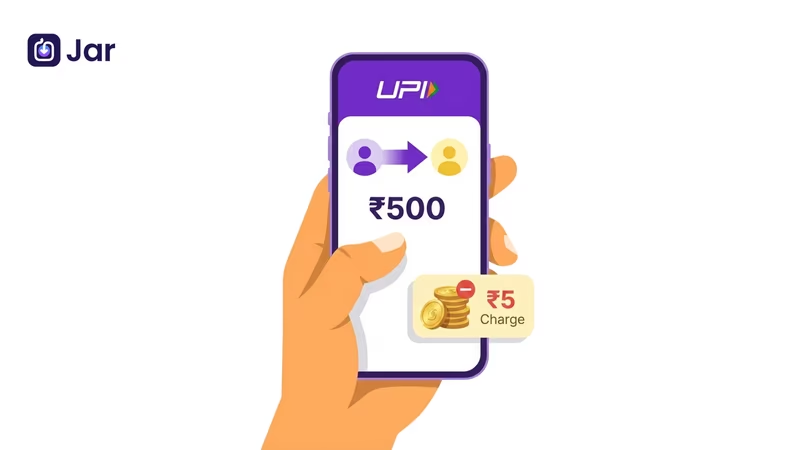


There have been a lot of speculations, developments, and even uncertainty lately about digital payments in India.
If you've seen a WhatsApp message or a news story that says "UPI is now chargeable!" you aren't the only one who is worried that your free money transfers are coming to an end.
The Unified Payments Interface (UPI) is still the backbone of India's cashless economy, handling billions of transactions as of January 2026.
But a lot of business means rules. Are we now paying for how easy it is?
You want to know if it will cost you more to send money to a buddy or pay the chaiwala.
The short answer is no.
For 99.9% of ordinary personal users, UPI is still entirely free.
The National Payments Corporation of India (NPCI) has, however, set particular fees for a small group of transactions that use Prepaid Payment Instruments (PPIs), such as digital wallets.
Why is there so much confusion? Headlines typically say something like "UPI Charges Introduced" without saying who pays them.
UPI Transaction Fees: Who Pays What?
To understand UPI transaction fees, we have to split UPI transactions into two main buckets. The rules are different for each.
Peer-to-Peer (P2P) Transactions
- What it is: Sending money to friends, family, or your landlord directly from your bank account to theirs.
- The Charge: ZERO.
- The Rule: There is absolutely no charge for P2P transactions, regardless of the amount (up to the daily limit). Whether you use Google Pay, PhonePe, Paytm, or BHIM, transferring money from your savings account to another person's savings account is free.
Peer-to-Merchant (P2M) Transactions
- What it is: Paying a shopkeeper, online store, or biller.
- The Charge: Mostly ZERO for you.
- The Twist: If you use your bank account to scan a QR code, it’s free. But, if you use a PPI (wallet) for a large transaction (over ₹2,000), the merchant might be charged a fee.
Key Takeaway: If you are a customer paying via your linked bank account, you can stop worrying. You are not paying any extra UPI fees.
The "1.1% Charge" Explained: PPI Interchange Fees
This is where the keyword "UPI charges news" really heated up. The NPCI introduced an interchange fee of up to 1.1% on specific merchant transactions.
What is an Interchange Fee?
In the world of payments, an interchange fee is a cost paid by the merchant's bank to the customer's bank (or wallet issuer) to cover the cost of accepting the payment.
The Rule for Wallets (PPI)
If you load money into your Paytm Wallet, PhonePe Wallet, or Amazon Pay balance (these are called PPIs) and then use that wallet balance to pay a merchant via UPI:
- Transaction under ₹2,000: No charges.
- Transaction over ₹2,000: An interchange fee of 1.1% is applicable.
CRITICAL NOTE: This fee is charged to the merchant, not the customer. When you buy a TV for ₹20,000 using your wallet, ₹20,000 is deducted from your balance. The merchant, however, might receive slightly less (after the fee is deducted), or they pay the fee separately.
Learn how to spot fake UPI payment scams and protect your money.
Interchange UPI Fee Rates by Category
Not all merchants pay the full 1.1%. The NPCI has categorized sectors to keep costs lower for essential services.
| Category | Interchange Fee (Paid by Merchant) |
| Fuel (Petrol Pumps) | 0.50% |
| Education, Agriculture, Utilities | 0.70% |
| Supermarkets (Kirana/Groceries) | 0.90% |
| Mutual Funds, Insurance, Govt Payments | 1.00% |
| Standard Retail/Online Shopping | 1.10% |
Why did they do this? Wallets incur costs (loading money, maintaining systems). Since UPI is generally free, wallet companies were losing money. This fee compensates them and encourages banks to support wallet interoperability.
Jar is an app that automatically detects your spare change from daily UPI transactions and saves it into 24K digital gold. Download Jar now.
New RBI Guidelines for UPI Transaction Charges (2025-2026)
Keeping up with RBI guidelines for UPI transaction charges is a full-time job. As of our current timeline in January 2026, here are the major updates you need to know.
The "Credit Line on UPI" Fees
Banks now allow you to link pre-approved credit lines to UPI. It acts like a digital credit card.
- The Charge: Similar to credit cards, merchants pay an MDR (Merchant Discount Rate) for these transactions.
- For You: It’s usually free to use, but late payments to the bank will attract interest, just like a credit card.
Transaction Limits Increased
To reduce the need for multiple small transactions (and system load), limits have been hiked.
- Standard Limit: ₹1 Lakh per day.
- Hospitals & Education: Enhanced to ₹5 Lakh per transaction.
- IPOs & RBI Retail Direct: Up to ₹5 Lakh.
- Insurance & Capital Markets: Up to ₹2 Lakh.
The "Cooling Period" for New Users
If you just created a new UPI ID, you can’t transfer ₹1 lakh immediately.
- First 24 Hours: Limited to ₹5,000 (varies slightly by bank).
- Reason: Fraud prevention.
Restricted Balance Checks
This is a new one. To save server bandwidth, apps now limit how many times you can check your balance.
- Limit: ~50 balance checks per day per app.
- Feature: Many apps now auto-display the balance after a transaction so you don't have to check it manually.
Check out the best UPI apps in India for 2026.
Detailed Scenarios: Am I Charged?
Let's play out a few common scenarios to see if transaction charges on UPI apply.
The Dinner Bill
- Situation: You go to a restaurant. The bill is ₹3,500.
- Method: You scan their QR code and pay via Google Pay (linked to SBI Savings Account).
- Result: FREE. There are no charges for you or the merchant in most cases.
The Wallet Power User
- Situation: You buy furniture online for ₹5,000.
- Method: You pay using Paytm Wallet balance via UPI.
- Result: FREE for you. The merchant pays a 1.1% interchange fee because it was a wallet transaction > ₹2,000.
The Fuel Station
- Situation: You fill petrol for ₹2,500.
- Method: You pay via PhonePe Wallet.
- Result: FREE for you. The petrol pump pays a reduced interchange fee of 0.5%.
Transfer to Friend
- Situation: You send ₹10,000 to your friend for a trip.
- Method: Any UPI App.
- Result: FREE. Personal transfers are always exempt.
Understand GST charges and limits on UPI payments
How to Avoid UPI Charges (Smart Tips)
Even though customers don't directly pay the UPI charges per transaction, merchants might start refusing wallet payments for large amounts to save their 1.1%. Here is how to ensure your payments never fail or cost extra:
Stick to Bank-to-Bank
Always keep your primary bank account as the default payment method. These transactions have the highest success rate and lowest cost for everyone involved.
Use UPI Lite for Small Payments
For transactions under ₹500, use UPI Lite. It’s faster, doesn't clutter your bank statement, and has zero failure rate.
Ask Before Using Wallets
If you are paying a small merchant a large amount (e.g., ₹3,000 to a local shop) using a wallet, ask them if they accept it. They might prefer a direct bank transfer to avoid the fee.
Watch out for "Platform Fees"
Some apps (like phone recharge platforms) have started charging a ₹1 to ₹3 "platform fee" regardless of payment mode. This isn't a UPI charge; it's an app usage charge. Switch apps if this bothers you.
Is UPI Still Viable?
If you are a business owner reading this, the UPI payment charges section is vital for you.
- Small Merchants (The Vegetable Vendor): If you are a small merchant (turnover < ₹20 Lakhs typically), standard UPI remains free. The government subsidizes these costs to promote digital adoption.
- Large Merchants: You are likely paying MDR on credit card UPI payments and interchange fees on wallet UPI payments > ₹2,000.
- The Benefit: Despite the fees, UPI is still cheaper than a traditional Credit Card Point-of-Sale (POS) machine, which charges 2% flat on almost everything.
See the full list of countries that accept UPI payments.
What's Next for UPI Fees?
As we move through 2026, the UPI charges and new rules discussion isn't over. Here is what analysts are watching:
- MDR Reintroduction? There is constant lobbying by banks to reintroduce a Merchant Discount Rate (MDR) on all UPI transactions to cover infrastructure costs. The government has resisted this so far to keep digital adoption high, but it’s a space to watch.
- Subscription Models: We might see apps offering "Premium UPI" experiences zero failures, priority support, and higher limits—for a monthly fee.
- International UPI: As UPI expands to France, Singapore, and the UAE, forex charges will apply. These will likely be around 1-3%, similar to international debit card usage.
Navigating the world of UPI transaction charges can feel like walking through a maze of jargon. But the bottom line for 2026 is reassuringly simple: UPI is still the people's payment method.
The government and the RBI are keen on keeping digital payments accessible. The charges that do exist are targeted at large merchants and wallet aggregators, shielding the common man from costs. So, go ahead and scan that QR code for your morning coffee or transfer rent to your landlord—your money is safe, and more importantly, your transaction is free.
Stay updated, pay smart, and keep your UPI PIN secret!
Disclaimer: Financial rules change rapidly. While this information is accurate as of January 2026 based on NPCI and RBI circulars, always check your specific bank's schedule of charges for the most granular details.
Frequently Asked Questions (FAQs)
Are there any charges in UPI?
No, for most people who use it personally. Standard bank-to-bank transfers, like sending money to a friend or paying a store owner using your savings account, are still completely free. But there are now fees for some kinds of transactions.
If you pay a merchant more than ₹2,000 with a Prepaid Payment Instrument (PPI) such a digital wallet (Paytm Wallet, PhonePe Wallet), you would have to pay an interchange fee of up to 1.1%.
This price is important since it is payable to the merchant, not you. However, businesses may eventually pass this cost on to you or cease accepting wallet payments for high-value items.
Is UPI no longer free?
For "common man" use (Peer-to-Peer), UPI is still free. The news stories about "UPI becoming chargeable" are about the new fees for merchants who use wallets (PPIs) and credit cards to make transactions.
You don't have to pay anything if you only link your bank account to an app and scan a QR code. The "free" time is over for big stores. They now have to pay fees to accept payments made with wallets and credit cards, just like they do for regular card machine swipes.
Does GPay charge for UPI?
When you utilize your linked bank account, Google Pay (GPay) doesn't charge for regular money transfers to friends or businesses.
However, GPay has added "convenience fees" or "platform fees" for several services, such paying utility bills (electricity, water) or recharging your phone, especially if you use a credit or debit card to pay that bill within the app.
These costs usually vary from ₹1 to ₹3 or a tiny percentage of the bill amount. However, pure UPI transfers are still free.
Is RuPay credit card use on UPI free up to ₹2000?
Yes, if you use a RuPay credit card on UPI for transactions up to ₹2,000, it is absolutely free for both you and the merchant (there is no Merchant Discount Rate or MDR).
For purchases beyond ₹2,000, you (the client) still don't pay any extra fees directly, but the merchant does have to pay an MDR fee, which is normally around 2%.
Some smaller stores might not accept credit card UPI payments for significant amounts because of this fee, but the system itself doesn't take any extra money from your account.
Are UPI transfers really free?
Yes, they are "really" free in that for normal Peer-to-Peer (P2P) and Peer-to-Merchant (P2M) bank transfers, no money is taken out of your account other than the amount being sent.
The government and the RBI see UPI as a "public good" and are currently paying for the infrastructure expenditures to encourage more people to use it.
Banks do have to pay to keep the servers running, but they can't charge users for basic UPI transactions for now. This keeps the service free for the end user.
What is the 2/3/4 rule for credit cards?
The 2/3/4 rule is a way to keep your credit score high and make sure you don't get turned down when you apply for new cards.
It says you shouldn't apply for more than two new credit cards every three months (or 30 days if you're strict), three cards every twelve months, and four cards every twenty-four months.
Even though it's not an official RBI guideline, a lot of banks use it as a risk metric. If you apply for too many cards too rapidly, you may look "credit hungry," which might drop your credit score and cause your applications to be turned down.