


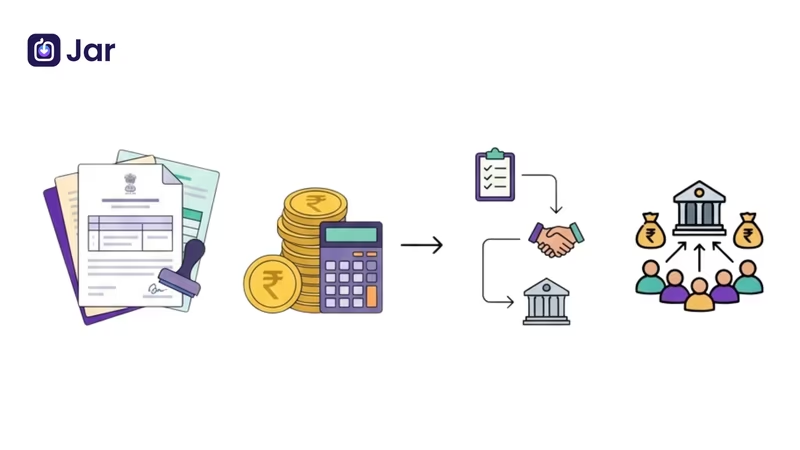


So, you want to change the world? That’s fantastic. Whether you are passionate about education, charity, promoting art, or even starting a microfinance venture to help small businesses, you need the right legal vehicle to get started.
In India, if you want to run a non-profit organization (NPO) that looks and feels like a professional corporate entity, a Section 8 Company is your gold standard.
I’ve dug through the best resources out there (so you don't have to) to bring you this all-in-one guide. We’re going to cover everything from "what exactly is it" to the nitty-gritty of registration fees, microfinance rules, and how it beats running a trust or society.
What is a Section 8 company?
In simple terms, a Section 8 Company is a non-profit organization (NPO) registered under the Companies Act, 2013.
Think of it as a company with a conscience. Unlike a regular business that exists to fill the pockets of its shareholders, a Section 8 company exists to promote:
- Commerce, art, science, sports, education, and research.
- Social Welfare, Religion and charity
- Protection of the Environment
The Golden Rule: You cannot pocket the profits. Any income or profit the company makes must be reinvested back into the company to further these charitable objectives. You cannot pay dividends to your members.
- Note: If you’ve been around a while, you might remember these as "Section 25 Companies" under the old 1956 Act. It’s the same concept, just a new name and better rules.
Why Choose Section 8? (The Big Advantages)
Why go through the trouble of registering a company instead of just starting a simple trust? Here is why Section 8 is often the superior choice:
- Credibility & Trust: Because the Central Government licenses you, donors, stakeholders, and international agencies trust you more.
- Limited Liability: This is a lifesaver. If the company runs into debt, your personal assets are safe. You are only liable for the unpaid shares you hold (if any).
- Tax Exemptions: You can apply for 12A and 80G registrations, which means your income is tax-free, and donors get tax deductions on their donations.
- No Minimum Capital: You don’t need a pile of cash to start. There is zero minimum paid-up capital requirement.
- Separate Legal Entity: The company has its own identity. It can buy property, sue, and be sued in its own name. It continues to exist even if the founders leave (Perpetual Succession).
- Stamp Duty Perks: In many states, Section 8 companies are exempt from the heavy stamp duty fees usually paid during incorporation.
- Foreign Contribution (FCRA): It is generally easier for Section 8 companies to eventually register for FCRA to accept foreign funding compared to other structures.
Explore the vast network of Reliance companies and see how they power one of India’s biggest business empires.
Section 8 vs. Trust vs. Society: Which Is Best for You?
| Feature | Trust | Society | Section 8 Company |
| What is it? | An agreement where one party holds assets for another. | A collection of people coming together for a literary, scientific, or charitable purpose. | A non-profit enterprise with a corporate structure. |
| Governing Act | Indian Trusts Act, 1882 | Societies Registration Act, 1860 | Companies Act, 2013 |
| Minimum Members | 2 Trustees | 7 Members (5 in some states) | 2 Directors/Shareholders |
| Main Document | Trust Deed | MOA and Rules & Regulations | MOA and AOA (Articles of Association) |
| Management | Trustees (often family members) | Governing Body/Council | Board of Directors |
| Family Control | High (Family members can be trustees) | Low (Family dominance is restricted) | Low (Professional management preferred) |
| Cost to Setup | Low | Medium | High |
| Annual Compliance | Minimal | Moderate (Annual list of members) | High (Annual returns, audits, ROC filings) |
| Transparency | Lower | Moderate | High (Data is public) |
- The Verdict: If you want a small, family-run charity, a trust might be easier. If you want to run a professional, scalable organization (like a school, hospital, or microfinance firm), Section 8 is the winner.
Section 8 vs. Private Limited Company
How is it different from a regular private limited company?
- Purpose: Pvt Ltd is for profit. Section 8 is for Charity/Social Welfare.
- Profits: Pvt Ltd distributes profits as dividends. Section 8 reinvests profits into the cause.
- Name: Pvt Ltd must use "Private Limited" in its name. Section 8 is privileged; it does not need to use "Pvt Ltd." It can use words like "Foundation," "Association," "Council," etc.
- License: Section 8 requires a special Central Government license; Pvt Ltd does not.
Discover who the Big 4 firms are and understand the global influence that keeps them at the top of the corporate world.
Eligibility & Characteristics: Who Can Apply?
To register, you must meet these criteria:
- Person or Association: An individual, a group of people, or even an existing company can be a member.
- Objectives: You must prove to the government that your intent is genuinely charitable (science, sports, religion, social welfare, etc.).
- Profit Clause: Your MOA must clearly state that profits will NOT be distributed as dividends.
- Directors: You need a minimum of 2 directors (at least one must be an Indian resident).
- Shareholders: You need a minimum of 2 shareholders (they can be the same people as the directors).
Documents Required for Registration
Get your paperwork ready before you start!
For Directors/Shareholders:
- PAN Card (Mandatory for Indian nationals)
- Passport (Mandatory for foreign nationals)
- Aadhaar Card / Voter ID / Driving License (Address Proof)
- Latest Bank Statement / Electricity Bill / Mobile Bill (Not older than 2 months)
- Passport-sized photographs
For the Registered Office:
- Electricity Bill / Water Bill / Gas Bill (Latest)
- Rent Agreement (if rented) + NOC from the owner
- Property Deed (if owned)
Get an overview of the leading pharma companies shaping India’s healthcare and driving industry growth.
7. Step-by-Step Registration Process
Registration is now fully online via the MCA (Ministry of Corporate Affairs) portal using the SPICe+ forms.
- Obtain DSC (Digital Signature Certificate): Since everything is online, all directors need a digital signature.
- Name Reservation: You need a unique name. It should usually end with words like Foundation, Forum, Association, Federation, Chamber, Confederation, Council, Electoral Trust, etc.
- Drafting MOA & AOA: You must draft the Memorandum of Association (MOA) and Articles of Association (AOA). Note: For Section 8, the physical filing of MOA/AOA is often required instead of the e-MOA depending on the specific customization of objectives.
- Apply for License (Form INC-12): This is the most critical step. You apply to the Regional Director/ROC for the "Section 8 License." You’ll need to submit your future income/expenditure estimates for the next 3 years here.
- Incorporation (SPICe+ Form): Once the license is approved (or simultaneously in the integrated process), you file the SPICe+ form to get your Certificate of Incorporation, PAN, and TAN.
Timeline: It typically takes 15–20 working days, provided your documents are perfect.
Section 8 Company Registration Fees
The cost varies depending on the authorized capital and the state you are in (due to stamp duty).
- Government Fees (MCA):
- Name Approval: ₹1,000
- License Fee & Incorporation: ~₹2,000 - ₹5,000 (Varies by capital)
- DSC & DIN: ~₹1,500 - ₹2,000 per director
- Stamp Duty: Varies by State. (e.g., Maharashtra is higher than Delhi; some states are exempt).
- Professional Fees:
- Since the paperwork (especially the MOA/AOA drafting and Income projections) is complex, CAs/CSs charge professional fees.
Total Estimated Cost:
- Basic Registration: ₹15,000 – ₹25,000 (for a standard Section 8 company with minimum capital).
Section 8 Microfinance Company: Fees & Rules
Many people want to start a Section 8 company specifically for microfinance (providing small loans to the poor).
Is it allowed?
Yes. You can register a Section 8 company for "microcredit" activities. The advantage is that you do not need the massive ₹5 Crore capital required for a regular NBFC (Non-Banking Financial Company), and you don't need immediate RBI approval for small-scale lending.
Key Restrictions for Section 8 Microfinance:
- Max Loan Amount: Usually capped at ₹50,000 for business and ₹1.25 lakh for housing per borrower.
- Interest Rate: Capped (typically around 26% max, subject to RBI guidelines).
- No Deposits: You CANNOT accept deposits from the public. You can only lend your own funds or funds raised via donations/directors.
Section 8 Microfinance Company Registration Fees:
Because the drafting for a microfinance license is more technical and requires specific compliance clauses to satisfy the ministry:
- Professional & Govt Fees: Expect to pay between ₹110,000 and ₹150,000.
- Why so high? It involves specialized drafting of the MOA to ensure the "Micro Credit" object is approved without triggering an immediate NBFC rejection by the ROC.
Annual Compliance & Penalties
A Section 8 company is "high maintenance" compared to a Trust. You must file:
- Auditor Appointment (Form ADT-1)
- Financial Statements (Form AOC-4)
- Annual Return (Form MGT-7)
- Income Tax Return (ITR-6)
Penalties:
If you fail to comply, you face heavy fines (starting from ₹100 per day of delay) and your Section 8 license can be revoked, turning you into a normal taxable company!
Running a Section 8 company requires financial discipline. Why not apply that same discipline to your personal savings?
Join millions of Indians who are using Jar to save daily in 24K digital gold. Download Jap App now and start your journey.
Starting a Section 8 company is a noble journey. While the registration fees (approx. ₹15k–₹25k for standard, ₹1L+ for microfinance) and compliance are higher than a trust, the credibility and funding opportunities you unlock are unmatched.
Frequently Asked Questions (FAQs)
What is the difference between Pvt Ltd and Section 8?
The biggest difference lies in the purpose and profits. A private limited company is built to generate profit for its shareholders if the company makes money, the owners can pocket it as dividends. A Section 8 company, however, is a nonprofit organization. While it functions like a company (with limited liability and professional value), it is strictly forbidden from distributing profits to its members.
Any money it makes must be reinvested back into its charitable goals (like education, health, or charity). Also, Section 8 companies don't need to use "Pvt Ltd" in their name; they can use words like "Foundation" or "Association."
Can a Section 8 company earn money?
Yes, absolutely. A Section 8 company can earn revenue just like any other business. It can sell products, provide services, earn interest on investments, or receive grants. The restriction isn't on earning money; the restriction is on how you use it.
You cannot take that money home as profit. Every rupee earned must be used to further the company’s main objective (e.g., building more schools, helping more patients, or expanding microfinance operations).
Which is better, trust or a Section 8 company?
It depends on your vision. If you want to run a small, family-managed charity with low costs and less paperwork, a trust is better.
However, if you want to build a scalable, professional organization that attracts corporate CSR funds, international funding, or government contracts, a Section 8 Company is far superior. It is viewed as more credible and transparent by donors and investors because it is regulated by the Central Government.
Can a Section 8 company pay a salary?
Yes. Being a nonprofit doesn't mean everyone works for free. You can pay market-standard salaries to employees, managers, and even directors for the actual work they do.
However, the salary must be reasonable and for a specific service rendered. You cannot pay money to a director just for being a "member" or to distribute profit in disguise.
What is the minimum capital for a Section 8 company?
Zero. There is no minimum paid-up capital requirement to register a Section 8 Company. You can start with as little money as you want. This is a major advantage over other financial structures that often require a locked-in deposit.
Can a Section 8 company sell property?
Yes. Since a Section 8 Company is a separate legal entity, it can buy, own, and sell property (land, buildings, vehicles) in its own name.
However, if you sell a property, the money you get from the sale cannot be shared among the members. It must go right back into the company’s bank account to be used for its charitable activities.
How many members are required for a Section 8 company?
To start a Section 8 company, you need a minimum of two members (shareholders) and two directors. The members and directors can be the same people.
If you are registering it as a public limited structure (which is rare for small NGOs), you would need 7 members and 3 directors. But for most people, the "2+2" structure is the standard.