



Gold has served as a symbol of wealth and prosperity in India for centuries.
While most of us recognise it for its value and allure, there’s a lot more to the precious yellow metal than meets the eye.
Gold has a rich and fascinating history and has very gracefully blended itself into modern culture.
Understanding the fascinating facts about gold reveals why this element remains one of the most valued and sought-after metals on Earth.
Let’s learn some interesting and cool facts about the precious metal Gold.
Gold as an Investment
1. Gold is considered a safe-haven asset for investors in times of economic uncertainty and turmoil.
2. Gold is considered a hedge against Inflation as the price of gold rises with the cost of living, which helps preserve purchasing power when fiat currencies lose value due to inflation.
3. Traditionally, gold has held its value, as it is an ideal way of preserving wealth over generations.
4. Gold’s natural scarcity and high production cost are the reasons it holds value.
5. Gold as an investment asset is highly liquid, with well-established markets for buying and selling online and offline. This makes it easy to convert it into cash whenever required. One of the sources by which you can do this is by downloading the Jar app and saving daily.
Gold as a Natural Resource
6. Gold is a rare metal even more than diamond, and is the 58th rarest element on Earth
7. Gold has some Medicinal uses. It is used in medical treatment for diseases such as arthritis and to treat certain types of cancer.
8. About 160,000 tons of gold have been mined throughout history. Gold has been found on every continent of the world.
9. India is the second largest consumer of gold, followed by China, according to figures in 2018.
10. Gold is found in the human body. It is mostly found in the bloodstream, with tiny amounts of gold found in the liver, kidneys, and hair. As it is present in the natural environment, we absorb gold through food and water. As gold is an odourless and tasteless metal, it can be eaten as a food or drink as it is non-toxic. It is used as gold flakes and added to luxury foods and drinks.
Gold as an Element
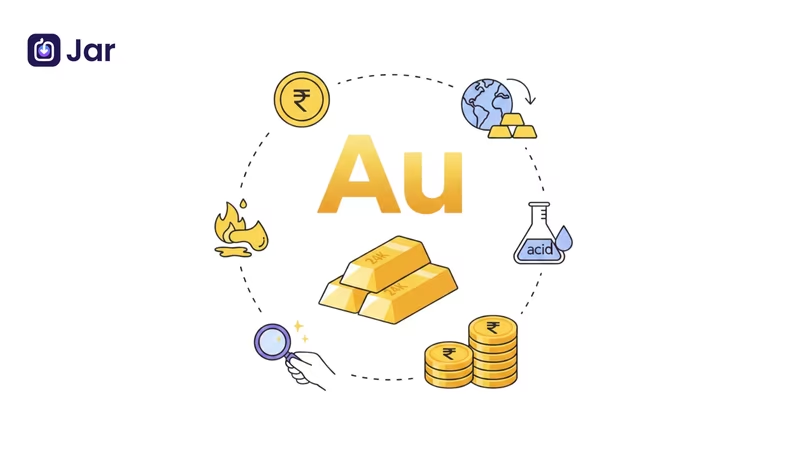
11. Gold has a chemical symbol, which is “Au”
12. The Atomic Number of Gold is 79, and its Atomic Weight is 196.96657
13. Gold melts at 1,063 °C (1,945 °F), while its Boiling Point: 2,966 °C (5,371 °F)
14. Gold is a dense metal that has a density of 19.3 grams per cubic centimetre, making it one of the heaviest elements
15. Other than Copper and Caesium, Gold is the only non-white coloured metal.
16. According to the American Heritage Dictionary, the colour of Gold is defined as "A light olive-brown to dark yellow, or a moderate, strong to vivid yellow”.
17. Gold is highly malleable. One ounce can be stretched into a thread 50 miles long without breaking.
18. Gold, as a metal, is highly Ductile. One ounce can be hammered into a sheet covering 300 square feet
19. Gold is corrosion-resistant, which means it does not tarnish, rust, or oxidise under normal conditions.
20. Gold is chemically inert, meaning it does not react with other chemicals or external elements, such as air, moisture, or most acids and bases.
21. Gold is an excellent conductor of both heat and electricity.
Gold as a Currency
22. Between 700-650 BC, Lydia produced the first gold coin. These coins were made of electrum, which is the naturally occurring alloy of Gold. These coins were used as a store of value in trade.
23. In ancient Egypt, around 3,100 BC, gold was used as the first currency for exchange or bartering. The Egyptian leader Menes defined the use of gold in the Egyptian economy by declaring its value, that is is “one part of gold is equal to two and a half parts of silver in value”.
24. The last country to peg its currency to a value in gold was the Swiss Franc.
25. About 25% of the world’s gold reserve is held by New York’s US Federal Reserve Bank.
26. The largest coins ever were cast at the Perth Mint in Western Australia, which weighed one tonne and measured about 80 cm (31.4 inches) in diameter.
Gold in different Technologies and Industries
Gold is used in a lot of technologies and industries. Here are a few of them and how they are used:
27. Automotive Industry: Safety features like ABS System and airbags use gold-plateed components.
28. Electronics: Gold is a good conductor of electricity and doesn’t rust or tarnish. It is used in Connectors, switches, relay contacts, Motherboards, processors, Smartphones, laptops, and tablets.
29. Aerospace & Aviation Technology: In space, materials face extreme temperatures and radiation. Gold is used because it withstands these conditions. It is used in Satellites and spacecraft circuits, Gold-coated visors in astronaut helmets, and Aerospace wiring and navigation systems.
30. Medical Technology and Healthcare Devices: Gold is biocompatible. It is used in Pacemakers, medical implants, Dental gold, Medical lasers, and imaging equipment, and in rapid diagnostic tests (like pregnancy tests and some COVID-19 kits). Gold is used in nanoparticles for accurate results.
31. Computers, AI Hardware and High-Performance Tech: Gold is used in high-end computing in semiconductors and microprocessors, high-frequency GPUs and AI chips, server farms, data centres, and cloud hardware, and quantum computing components.
32. Telecommunications & Networking: Gold keeps communication stable across long distances. It is used in fibre optic connectors, high-frequency radio systems, 5G and upcoming 6G equipment, and Satellite communication hubs. Gold coatings minimise signal loss and maximise.
33. Glass & Coatings Industry: Gold is used in gold-coated glass, which reflects heat. It is also used in skyscraper windows, luxury cars and high-end interiors. Red and Ruby-coloured glasses are made using gold chloride.
34. Energy and Renewable Technologies: Gold improves performance. In fuel cells, by acts as a catalyst. In Advanced solar panels as it enhances light absorption. And in electric vehicle components, which ensures efficient power transfer.
FAQ
What is gold made of?
Gold is a chemical element made of one type of atom, which is the gold atom and an atomic number of 79. It is not made of any mix or compounds. This element is represented by Au.
How did gold get its name?
The name “gold” comes from the Old English word “geolu” or “gulþ,” meaning yellow, referring to its natural colour. Its chemical symbol Au comes from the Latin word “Aurum,” which means shining dawn or glow of sunrise.
Which river is full of gold?
Gold is found in rivers like the Subarnarekha River in India and other rivers like the Indus River, Pakistan and the Subansiri River, India.
How much gold is in my blood?
On average, the human body contains 0.2 milligrams of gold. Human blood also contains other elements like iron, chromium, and zinc. The gold in the blood helps maintain joint health and proper functioning at the molecular level.
Is the Indian rupee backed by gold?
No, the Indian rupee is not backed by gold. India follows a fiat currency system, which means the currency is backed by the government’s authority, economic stability, and monetary policy and not by physical gold reserves.
Where is gold naturally found?
Gold is naturally in rocks and mineral deposits, riverbeds and alluvial deposits, underground veins(lodes), and in mountains formed by volcanic activities.